General information for hospital managers. It is not legal, clinical or infection control advice. Follow your own infection control committee, your sterilizer maker's instructions and the rules of your state. We reviewed the ERP sidebar on 30 September 2026 from a screen capture of the OneCity demo tenant.
What sits inside Housekeeping & Support
When you log in to the OneCity ERP as a super admin, the left sidebar lists every module group in a fixed order. The group called Housekeeping & Support opens to four entries. We list them exactly as the menu shows them, and we describe the hospital job behind each one rather than inventing screen detail. The depth of each screen changes as the product grows, so the last column tells you what to ask for in a live demo.
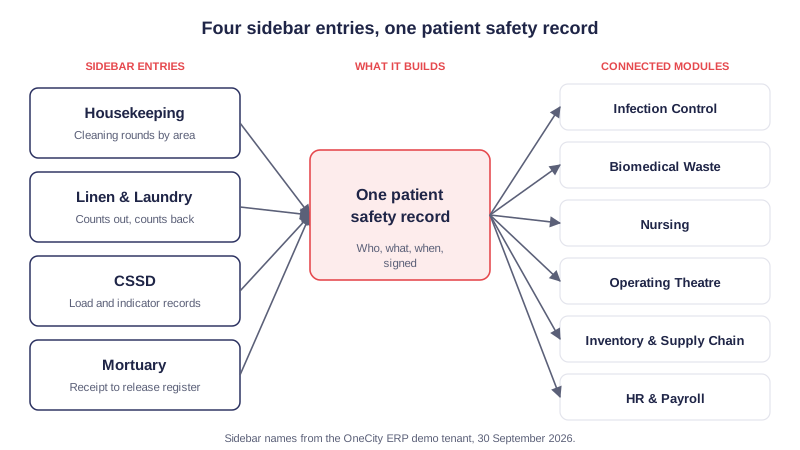
| Sidebar entry | The hospital job behind it | Ask to see in a demo |
|---|---|---|
| Housekeeping | Cleaning of wards, theatres, ICUs, corridors and toilets, with a frequency and a person responsible for each area | An area wise cleaning checklist, who signed it and when, and how a missed round shows up |
| Linen & Laundry | Clean linen issued to wards, soiled linen collected and sent to the laundry, whether in house or outsourced | Counts out and counts back, how infected linen is separated, and how a shortfall is flagged |
| CSSD | Central sterile services: receiving used instruments, packing, sterilising, storing and issuing sterile sets | A sterilizer load record with indicator results, and a way to trace a pack to a load |
| Mortuary | Receipt, identification, storage and release of the deceased, with the paperwork a family and the police may need | A body register with tag number, release authority and time, and the link to the death record |
Notice what is missing from the list. There is no menu for pest control, no menu for hospital kitchens and no menu for security guards. Kitchens belong to the Diet & Canteen module, and waste leaves the building through the Biomedical Waste module. We would rather show you the four entries that exist than a long feature list that does not match the product.
Why these four jobs belong in one module
A hospital administrator in a tier 2 city usually inherits these four jobs from four different histories. Housekeeping is often a contractor with a supervisor and a muster roll. Linen goes to a laundry that may be a private vendor or a room in the basement. The CSSD is run by a senior nursing sister or a technician and sits next to the operating theatre. The mortuary belongs to the casualty team or the pathology department. Each job has its own register, its own keys and its own habit of recording things after the fact.
Yet the failure modes are linked. A theatre cannot run without sterile sets, and sterile sets are useless if the pack was stored in a damp room that housekeeping did not clean. Linen that returns damp or torn becomes a surgical site risk. A body released to the wrong family is a legal and human disaster that no apology repairs. When an infection control nurse investigates a cluster of wound infections, she wants to ask four questions in one sitting: what was cleaned, which linen was used, which instruments were issued and which loads they came from. If the answers sit in four notebooks in four rooms, the investigation takes days.
The NABH accreditation standards, whose sixth edition took effect on 1 January 2025, treat this as a management problem. The standards have a chapter on facility management and safety and a chapter on infection prevention and control, and an assessor reading either chapter will ask to see records, not intentions. The standards document is published on the NABH portal, and we link it in the sources below so you can read the wording yourself. Our own guide to NABH 6th edition and hospital software explains how the digital side of the standard changed, and the NABH accreditation software page shows where the audit tools sit.
Housekeeping: a cleaning round you can prove
Everyone in a hospital believes the wards are cleaned. The question an infection control committee asks is different: can you show that this ICU bed was cleaned after the last discharge, with the right disinfectant, by a named person, before the next patient arrived. That is a record question. A hospital that cannot answer it has housekeeping in practice but not in evidence.
A workable housekeeping record has five parts. It names the area, so that every room, bay and corridor has a code. It sets a frequency, because an ICU bed and a records room need different schedules. It names the person or shift responsible. It records the disinfectant and the dilution used, since an over diluted solution cleans nothing. And it records exceptions, such as a terminal clean after an isolation patient leaves. Surfaces that many hands touch, such as bed rails, call buttons, door handles and trolley handles, need more frequent attention than floors, and the record should make that difference visible.
The Housekeeping entry in the OneCity sidebar is where this record belongs. When you sit through a demo, ask the presenter to open an ICU bed and show the last cleaning entry, then ask what happens if a round is missed. A system that only stores a PDF checklist is a filing cabinet. A system that knows a round is overdue and tells a supervisor is doing housekeeping work. We are open about the fact that module depth varies across a product with more than 200 modules, so this is the right test to apply to any vendor, including us.
The link to infection control matters more than the link to the cleaning contractor. Hand hygiene audits, surveillance of hospital acquired infections and outbreak tracing all need to know what was cleaned and when. Our Infection Control module page describes that side, and our guide to HAI surveillance and NABH infection control explains why surveillance data is only as good as the records behind it.
Linen & Laundry: counts out, counts back
Linen is the quiet cost centre of a hospital. Every bed uses sheets, pillow covers, a blanket and a draw sheet, and every theatre uses gowns and drapes. A 100 bed hospital changes thousands of items a week. When counts are not kept, the loss is invisible until the purchase request arrives for a new batch of bedsheets that nobody remembers losing.
The infection control side matters as much. Soiled linen should be bagged at the place it was used and not sorted in a patient room. Linen from isolation rooms and from theatres is kept separate from ordinary ward linen. Clean and soiled linen should never share a trolley or a route. These are routine principles that appear in infection control teaching material from many health departments, and they work only if every shift follows them the same way.
Washing has its own science. A commonly cited recommendation for hot water washing of healthcare linen is a temperature of at least 160 degrees Fahrenheit, which is about 71 degrees Celsius, for a minimum of 25 minutes. A public health presentation from the Wisconsin Department of Health Services states this figure, and we link it below. Low temperature washing is also used with suitable chemicals, so your laundry vendor's cycle sheet and your infection control committee's policy are the documents that decide for your hospital. What matters for software is that the cycle is written down and that a hospital can show which batch went through which cycle.
Many tier 2 and tier 3 hospitals send linen to a commercial laundry. In that case the Linen & Laundry entry is mostly a handover register: what left the ward, what the vendor counted on receipt, what came back and what was rejected. The most useful report is a simple one, the difference between counts out and counts back, by ward and by week. When a ward shows a steady gap, the conversation with the contractor or the ward in charge starts with a number instead of an accusation.
Stock of new linen belongs in the Inventory & Supply Chain module like any other consumable, and the ward side connects to the nursing station, since sisters are the people who request fresh sets and bag the soiled ones. Ask the vendor how a linen issue is raised from a ward, because that is where paper systems break first.
CSSD: the record that proves a set was sterile
The central sterile services department is the least visible and most unforgiving part of a hospital. A surgeon opens a sterile set and trusts it. If the set was not sterile, the patient pays months later with a deep infection, and the hospital cannot reconstruct what happened unless the CSSD kept a record for every load.
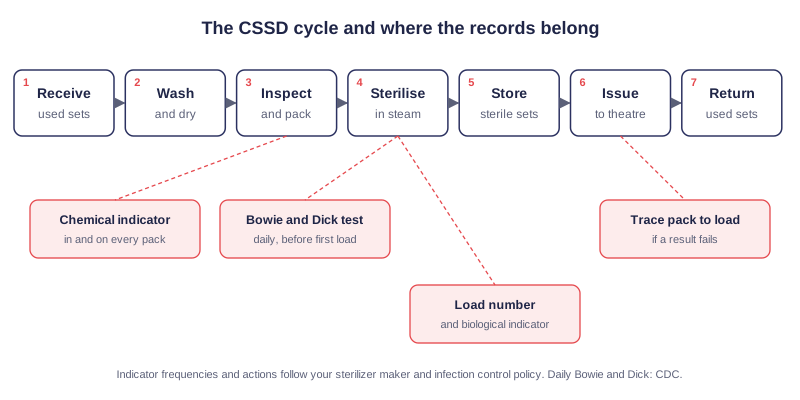
Four checks do most of the work. The first is the Bowie and Dick test. The United States CDC states that this test is used each day the vacuum type steam sterilizer is used, before the first processed load, and that a sterilizer which fails it must not be used until maintenance staff inspect it and it passes. The second is a chemical indicator. The CDC describes chemical indicators attached to the outside of a pack and placed inside it, so that the person opening the pack sees a colour change that shows the pack met the temperature or the time and temperature needed. The third is the biological indicator, a vial containing spores of Geobacillus stearothermophilus, which is the organism used to monitor steam sterilization. The fourth is the load record itself: which sterilizer, which cycle, which operator, which packs.
Frequencies for biological indicator testing, and the action to take after a positive result, come from your sterilizer maker, your national guidance and your infection control committee, so we do not state a number here. Read the CDC guidance on steam sterilization, linked below, for the principles, and then write your own policy.
What should software do? It should make the right behaviour the easy behaviour. A load record should be opened before the cycle starts, the Bowie and Dick result should be entered before the first load of the day, the indicator results should be entered before the packs are released, and the packs should carry a label that links back to the load. Traceability is the point. If a biological indicator from one cycle turns positive, the hospital needs to find every pack from that cycle in minutes, including any that have already reached the theatre.
The CSSD entry in the OneCity sidebar is the home for this record, and the nearest module is the Operating Theatre module, since theatres are the biggest consumers of sterile sets. In a demo, ask the presenter to trace one pack back to its load, and ask how the system behaves when the daily test has not been entered. If the answer is a screen showing a gap, you have what you need. If the answer is a general statement, you have a diary.
Mortuary: a register that stands up to questions
Few hospital managers enjoy thinking about the mortuary, and that is why it goes wrong. The mortuary holds the one record where an error cannot be corrected later. A body must be identified when it arrives, tagged, stored in a numbered place, and released only to an authorised person with the right documents. Every handover needs a time and a name.
Several documents travel with a death in India. A medical certificate of cause of death is issued by the treating doctor under the Registration of Births and Deaths Act, 1969, and the death must be registered with the local registrar. Deaths that are medico legal, such as road accidents, poisoning, burns and suspicious deaths, follow police procedure and a postmortem, and the body is released only on the authority named in that process. Our guide to the medico legal case register explains why the hospital side of that register must be complete and time stamped.
A sound mortuary register captures the identity details and the source ward, the tag number, the storage position, the time of entry, the doctor who certified the death, whether the case is medico legal, the person who collected the body with proof of relationship, and the time of release. A second view lists bodies currently held, with the time since arrival, so that nobody discovers a forgotten entry during an audit. Unclaimed bodies need a separate path, and your legal advisor and the local police decide it.
Ask for the same discipline you would ask of a pharmacy stock register. Nothing should leave without a record, and nothing should be edited without a trace. The audit trail in the OneCity ERP, which appears under the Compliance & Quality group, is the place to confirm that edits to a body register are logged.
How the module connects to the rest of the ERP
Back of house modules fail when they behave like islands. The point of putting these four jobs inside one ERP is that each can read what the others already know. In a well connected setup, the nursing station raises a linen request for a bed that the IPD module shows as vacant. The infection control team sees terminal clean records for rooms that held isolation patients. The theatre schedule shows which instrument sets are booked, and CSSD sees demand a day ahead. Waste produced in the same rooms is weighed and manifested through the biomedical waste record, and our guide to the BMW Rules 2016 and digital manifests shows what that record must contain.
Staff are the other connection. Housekeeping and laundry teams are usually the largest group of contract workers in a hospital, and attendance, shift patterns and pay depend on the HR & Payroll module. Doing this properly means that the supervisor who marks a cleaner present on a muster roll is the same system that records the cleaning round.
We cannot promise that every one of these connections is live in every deployment. What we can say is that the modules share one patient and one facility database, which is why the connections are possible at all, and that you should ask for each connection you care about to be shown on real screens. The full module list shows the other groups in the sidebar, and our hospital management software guide explains how they fit together for a tier 2 or tier 3 hospital. Both are linked at the end of this page.
Questions to ask any vendor before you buy
These questions work for OneCity and for every competitor. A vendor who answers them with a live screen is serious. A vendor who answers them with a slide is selling a promise.
- Show me the cleaning record for one ICU bed, including the person, the time and the disinfectant, and show me what happens when a round is missed.
- Show me how soiled linen is counted out of a ward and counted back from the laundry, and how a gap is reported.
- Show me a CSSD load with its indicator results, then trace one pack to that load.
- Show me what the system does when the daily sterilizer test has not been entered.
- Show me a mortuary register entry from arrival to release, and the log of any edit made to it.
- Show me which reports an infection control nurse can pull across all four jobs for one ward over one month.
- Show me how a contractor's staff are marked present, and how that connects to the cleaning record.
A tier 2 hospital with a small CSSD may decide that a simple register is enough for now, and that is a fair choice. The test is whether the system will still serve you when the hospital grows from 50 beds to 150, when a second theatre opens and when the first NABH assessment arrives.
What this page does and does not claim
The four sidebar entries come from a screen capture of the OneCity ERP demo tenant taken on 30 September 2026. We did not describe fields we have not seen. Where this page says what a hospital needs, that is general operating guidance from public sources, and where it says what to ask for, that is our advice to you as a buyer. OneCity does not hold a NABH certificate for its software, and nothing on this page says that using any module makes a hospital NABH compliant. The hospital earns accreditation by its own practice, and software only keeps the evidence tidy.
If you want to see the module on your own data, book a demo and bring your CSSD, linen and mortuary registers with you. The pricing page shows the plans, and we suggest confirming module inclusion for your plan in writing.
Frequently asked questions
What does the Housekeeping & Support module include in OneCity?
In the OneCity ERP sidebar, the group has four entries: Housekeeping, Linen & Laundry, CSSD and Mortuary. Each one is the place for the records of that job. Ask for a live walkthrough of every entry, because the depth of each screen changes as the product grows.
Is CSSD software required for NABH accreditation?
NABH does not require a particular software product. It expects the hospital to run sterilisation with documented processes, validation and records, and an assessor will ask to see them. Software helps keep those records complete, but paper registers that are complete also satisfy the evidence need.
How often should a Bowie and Dick test be done?
The United States CDC says the test is used each day the vacuum type steam sterilizer is used, before the first processed load. Follow your sterilizer maker's instructions and your infection control committee's policy, and record every result.
What water temperature is recommended for washing hospital linen?
A commonly cited figure for hot water washing is at least 160 degrees Fahrenheit, about 71 degrees Celsius, for at least 25 minutes. Low temperature washing with suitable chemicals is also used, so follow your laundry vendor's validated cycle and your infection control policy.
Can the module handle an outsourced laundry?
An outsourced laundry still needs a handover record: what left each ward, what the vendor counted, what came back and what was rejected. Ask the presenter to show counts out against counts back for a ward. We do not claim features beyond what a demo shows.
Does the mortuary entry replace the medico legal case register?
No. The medico legal register records the case and the police intimation, while the mortuary register records custody of the body. A good setup links the two, so a medico legal body is not released without the authority named in the case.
Is the Housekeeping & Support module included in the free or Starter plan?
We do not state plan inclusion for this module on this page. Check the pricing page and ask for written confirmation of which modules your plan includes before you sign.
Sources
NABH Hospital Accreditation Standards, 6th edition, January 2025 (portal.nabh.co). CDC guidance on steam sterilization monitoring, including the daily Bowie and Dick test and chemical indicators (cdc.gov). Wisconsin Department of Health Services, healthcare laundry education presentation, for the commonly recommended hot water wash temperature and time (dhs.wisconsin.gov). The ERP sidebar names come from a screen capture of the OneCity demo tenant dated 30 September 2026. This page is general information. It is not clinical, legal or infection control advice, and standards and state rules change, so confirm every point with your infection control committee, NABH and the relevant authority.
Related reading
Bring your CSSD, linen and mortuary registers to a live demo and see them on screen.
Book a demo