General information for hospital managers and finance teams. It is not tax, accounting or legal advice. Your chartered accountant decides your depreciation method and rates. We reviewed the ERP sidebar on 30 September 2026 from a screen capture of the OneCity demo tenant.
What sits inside Asset Management
In the OneCity ERP, the left sidebar lists the module groups in a fixed order. Asset Management follows Ambulance and sits next to Facility & Maintenance. It opens to two entries, and we describe them as they appear rather than adding screens we have not seen.
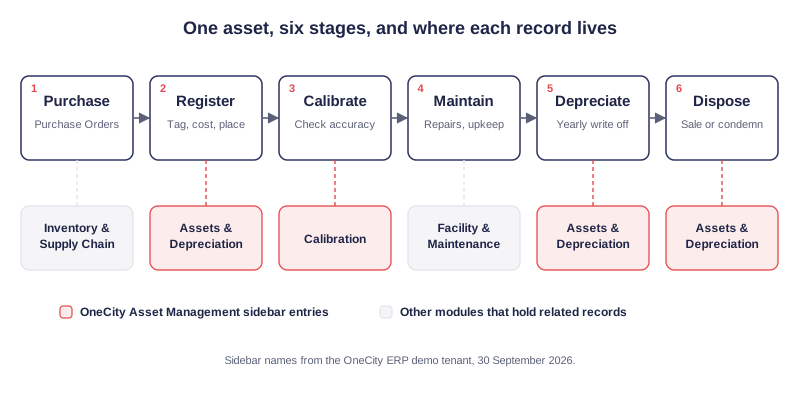
| Sidebar entry | The question it answers | Ask to see in a demo |
|---|---|---|
| Assets & Depreciation | What do we own, where is it, what did it cost, and what is it worth now on the books | One asset with its cost, date, location, useful life and a depreciation schedule, and what happens when it is sold or written off |
| Calibration | Has this instrument been checked against a standard, by whom, and when is the next check due | A due list sorted by date, a certificate attached to an instrument, and what shows when a date is missed |
Two other jobs often get lumped into asset management, and they have their own homes. Repairs and breakdowns are handled as work orders in the Facility & Maintenance module. Consumables that are used up, such as syringes and sutures, belong to the Inventory & Supply Chain module. A ventilator is an asset. The tubing that goes with it is stock. Keeping that line clear is the first discipline of any register.
Our separate guide on biomedical equipment and asset tracking covers the operations side in depth, including maintenance contracts and the regulatory bodies that look at radiation and laboratory equipment. This page is about the module itself and the accounting that sits behind it, so the two pages do not repeat each other.
Why a hospital register goes wrong
Most hospitals do have an asset register. It is usually a spreadsheet created for the last audit by someone who has since left. It lists the big items, a CT scanner and a few ventilators, and misses the hundreds of smaller items that add up: infusion pumps, syringe pumps, suction machines, patient monitors, autoclaves, ultrasound probes, laminar flow cabinets and a fleet of wheelchairs. When a new ward opens, the register is not updated. When a pump moves from the ICU to the emergency room, nobody records the change. When the assessor asks for the calibration record for a specific defibrillator, a nurse spends an afternoon looking through files.
Three failures repeat across hospitals of every size. The first is identity: two machines of the same make carry the same name and nobody can tell which one a service report belongs to. The second is location: the register says the item is in theatre two, and it is in a cupboard in another building. The third is dates: the warranty ended and nobody noticed, the calibration lapsed, and the insurance renewal was missed. A register that fixes identity, location and dates already prevents most of the pain.
Each asset needs a unique tag number that is physically stuck on the machine, and the tag must be the key in the register. Everything else, including the make, the model, the serial number, the supplier, the purchase date, the cost, the department and the person responsible, hangs off that number. When a machine is moved, the tag number travels and the location record changes. When it is condemned, the tag is closed and not reused.
Assets & Depreciation: the accountant's half of the register
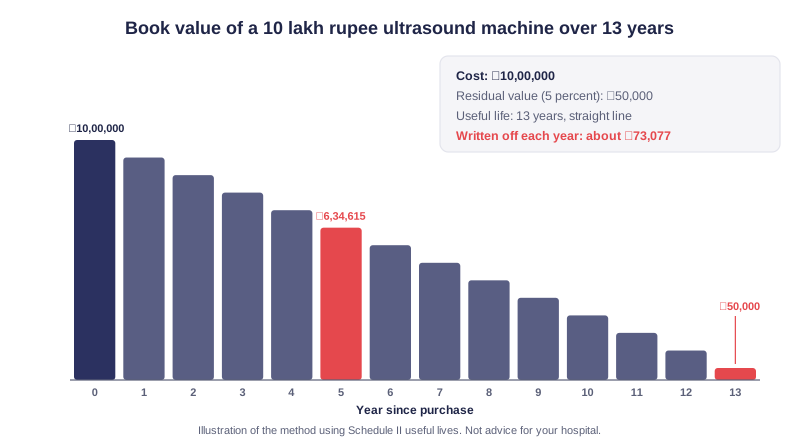
Depreciation is the accounting practice of spreading the cost of an asset over the years it is useful. A hospital that buys a ₹10,00,000 ultrasound machine does not have a ₹10,00,000 expense in the first year. It has an asset that loses value over time, and the loss is recorded year by year. The amount recorded each year affects the profit shown in the accounts, the tax payable, and the value shown on the balance sheet that a bank sees when it considers a loan.
For companies in India, Schedule II to the Companies Act, 2013 sets the useful life that a company applies unless it justifies a different one. In Part C, the schedule lists electrical machinery, X ray and electrotherapeutic apparatus and accessories, and medical and diagnostic equipment such as CT scan machines, ultrasound machines and ECG monitors at 13 years, and other medical and surgical equipment at 15 years. It also says that the residual value of an asset should generally be not more than 5 percent of its original cost, and that when a significant part of an asset has a different useful life from the rest, that part's life is worked out separately. This is called component accounting. The schedule is linked in the sources below, and your auditor will confirm how it applies to your hospital.
A hospital run as a trust, a society or a partnership may follow a different framework, and tax law has its own depreciation rules that differ from the Companies Act. Many finance teams therefore keep two views of the same asset: one for the books and one for the tax computation. Ask any vendor whether the register supports that, and ask your chartered accountant which view matters for your structure. We do not state tax rates on this page, because the rules change and the right answer depends on your entity.
A worked example you can check by hand
Take an ultrasound machine bought for ₹10,00,000. Using the 13 year life that Schedule II gives for this class of equipment and the 5 percent residual value the schedule treats as a ceiling, the residual value is ₹50,000. The amount to write off over the machine's life is ₹10,00,000 minus ₹50,000, which is ₹9,50,000. Spread evenly over 13 years under the straight line method, that is about ₹73,077 a year. After five years the total written off is about ₹3,65,385, and the book value is about ₹6,34,615. After 13 years the book value reaches the residual value of ₹50,000.
Real life adds complications. The machine may be bought part way through a year, so the first year's charge is for a fraction of the year. A probe, which wears out faster than the console, may be a significant component with its own life. A donated machine has a different cost base. The machine may be sold or written off as beyond economic repair before the end of its life, and then the register must record the disposal and the gain or loss. A register that handles only the simple case will give wrong numbers in the real cases, so ask the vendor to walk you through a mid year purchase and a disposal.
The Assets & Depreciation entry in the OneCity sidebar is the home of this record. The depreciation charge should reach the ledgers kept in the Accounts & Finance module, and that connection is what a finance head should test first. Ask the presenter to run the depreciation for a month and then open the journal it creates. If the journal appears as a draft that a person reviews, the controls are in the right place. If numbers must be re entered by hand, the register saves little work.
Calibration: the assessor's half of the register
Calibration means comparing an instrument against a reference standard of known accuracy and adjusting or documenting the difference. A weighing scale that reads 400 grams over, a thermometer that reads 2 degrees under, an infusion pump that delivers 8 percent less than the set rate: each is a patient safety problem, and none can be spotted by looking at the machine. The only protection is a schedule of checks, performed by a competent person against a traceable standard, with a certificate that says what was found.
NABH accreditation looks at this directly. The standards published by NABH have a chapter on facility management and safety, and one of its themes is that a hospital plans, maintains and documents its medical equipment. An assessor will pick a few machines at random and ask for the inventory entry, the maintenance record and the calibration record. A hospital with a clean register answers in a minute. A hospital without one has a bad afternoon. The NABH standards document is linked in the sources below, and our guide to NABH accreditation software shows where the audit tools sit in the ERP.
The people who calibrate matter as much as the dates. Calibration laboratories in India can be accredited by NABL, the National Accreditation Board for Testing and Calibration Laboratories, under the international standard for testing and calibration laboratories, ISO/IEC 17025. A certificate from an accredited laboratory carries more weight than a note from an unaccredited technician. Radiology equipment has an additional layer, because the Atomic Energy Regulatory Board licenses and monitors medical radiation equipment, and quality assurance tests are part of that regime. Our guide to the AERB licence for hospital X ray and CT explains the process, and the AERB site is linked below.
Do not confuse instrument calibration with laboratory quality control. The Laboratory module in the OneCity sidebar has its own entries for QC Materials, QC Runs and EQAS Programs, because a pathology lab checks its analysers every day with control samples and joins external quality assurance programmes. The Calibration entry under Asset Management is the home for the periodic calibration of equipment across the hospital, and the two work together. Our guide to NABL and ISO 15189 laboratory accreditation shows what the laboratory side expects, and the Laboratory module page covers the LIS.
What should software do for calibration? It should hold a due date for every instrument that needs one, show the list sorted by date, make an overdue instrument visible to the person who can remove it from service, and hold the certificate against the instrument so that nobody searches through files. For imaging equipment, ask how the register records quality assurance tests, and look at the Radiology module page for the clinical side.
What belongs in the register besides machines
A hospital's assets are wider than its biomedical equipment, and a register that covers only machines leaves gaps in the accounts. Furniture and fittings, such as beds, trolleys, cupboards and air conditioners, carry a cost. Computers, servers and network equipment have short lives. Vehicles are an important category, since ambulances have regulations of their own, and the Ambulance Dispatch module covers their operational side. Buildings, leasehold improvements and the fit out of a new wing form another class, usually capitalised once and depreciated over a long life.
Your finance team decides the capitalisation threshold, the amount below which a purchase is treated as an expense, and the policy should be written down and applied consistently. A low threshold gives a thorough register and a lot of work. A high threshold keeps the register short and hides small items that matter clinically. Many hospitals handle this by keeping a separate clinical equipment list for items of any value that need calibration, and a financial register for items above a threshold. Ask whether the system lets an item be tracked for calibration without being capitalised.
Questions to ask any vendor before you buy
These questions work for OneCity and for every competitor. The right test is a live screen, not a slide.
- Show me one asset with its tag number, location, cost, purchase date and useful life, and show me how a transfer between departments is recorded.
- Run depreciation for one month and show me the journal it creates, and who approves it.
- Show me a mid year purchase, a part replaced as a separate component and a disposal with a gain or loss.
- Show me the calibration due list for the next 60 days, sorted by date, with the person responsible.
- Show me what happens when a calibration date is missed, and whether the instrument can be flagged out of service.
- Show me how a calibration certificate is stored against the instrument.
- Show me the register as an assessor would ask for it: a random machine, its maintenance record and its calibration record, in under two minutes.
- Show me how the register can be exported if we ever change systems.
A small hospital may not need component accounting this year. The question to ask is whether the register will cope when the hospital buys its first CT scanner or when a chartered accountant joins the team.
What this page does and does not claim
The two sidebar entries come from a screen capture of the OneCity ERP demo tenant taken on 30 September 2026. We did not describe fields we have not seen, and the depreciation example above is an illustration of the method, not a screenshot of the product. The useful lives come from Schedule II of the Companies Act, 2013 as published on a public bare act library, and they apply to companies, so confirm the right approach for your structure with your chartered accountant. OneCity does not hold a NABH certificate for its software, and nothing on this page says that using the module makes a hospital NABH compliant.
If you want to see the register on your own equipment list, book a demo and bring a spreadsheet of your assets with you. The pricing page shows the plans, and we suggest confirming module inclusion for your plan in writing.
Frequently asked questions
What does the Asset Management module include in OneCity?
In the OneCity ERP sidebar, the group has two entries: Assets & Depreciation, and Calibration. The first holds the register and its depreciation. The second holds calibration dates and records. Ask for a live walkthrough, because the depth of each screen changes as the product grows.
What useful life does the Companies Act give for hospital equipment?
Schedule II, Part C lists X ray and electrotherapeutic apparatus and medical and diagnostic equipment such as CT scan, ultrasound and ECG monitors at 13 years, and other medical and surgical equipment at 15 years. A company may justify a different life. Confirm the position for your hospital with your chartered accountant.
How much residual value can I assume?
Schedule II says the residual value of an asset should generally be not more than 5 percent of its original cost. Many hospitals use that figure or a lower one. Your auditor reviews the choice.
How often should hospital equipment be calibrated?
It depends on the instrument, the maker's instructions, the risk and the hospital's own policy, so there is no single interval. Record the interval you set for each instrument, keep the certificate, and treat a missed date as a safety event.
Is calibration the same as laboratory quality control?
No. Calibration compares an instrument against a reference standard at planned intervals. Laboratory quality control runs control samples through an analyser, usually every day, and external quality assurance compares your results with other laboratories. A hospital needs both.
Does NABH require asset management software?
No. NABH expects a hospital to plan, maintain and document its medical equipment and to show records on request. A complete paper register meets the evidence need. Software makes the records easier to keep current and easier to search.
Is the Asset Management module included in the free or Starter plan?
We do not state plan inclusion for this module on this page. Check the pricing page and ask for written confirmation of which modules your plan includes before you sign.
Sources
Companies Act, 2013, Schedule II, useful lives to compute depreciation (advocatekhoj.com). NABH Hospital Accreditation Standards, 6th edition, January 2025 (portal.nabh.co). Atomic Energy Regulatory Board, including the eLORA licensing portal (aerb.gov.in). The ERP sidebar names come from a screen capture of the OneCity demo tenant dated 30 September 2026. The depreciation example is our own illustration. This page is general information. It is not tax, accounting or legal advice, and rules change, so confirm every point with your chartered accountant and the relevant authority.
Related reading
Bring your equipment list to a live demo and see it as a register with dates.
Book a demo