General information for hospital administrators and engineering heads. It is not legal, safety or engineering advice. Follow your engineer, the maker's instructions and the rules of your state. We reviewed the ERP sidebar on 30 September 2026 from a screen capture of the OneCity demo tenant.
What sits inside Facility & Maintenance
In the OneCity ERP, the left sidebar lists module groups in a fixed order, and Facility & Maintenance comes after Asset Management and before CRM & Feedback. The capture we reviewed shows the group header and a single entry under it.
| Sidebar entry | The hospital job behind it | Ask to see in a demo |
|---|---|---|
| Work Orders | Raising, assigning, tracking and closing a repair or maintenance request for any part of the building or its utilities | A request raised from a ward, assigned to a technician, completed with parts and time, and signed off by the requester |
One entry is a modest list, and we would rather say so than pad it. Some things a hospital engineer might expect are not visible in the sidebar, and we do not claim them. We do not list a preventive maintenance calendar, a utility meter log or a fire equipment register as separate menu entries. If those matter to you, ask in the demo whether a work order can be created on a schedule, and how the hospital records planned inspections. A good answer shows the screen. A vague answer tells you what the product does today.
Two neighbouring modules cover the jobs that people often expect in a maintenance system. Equipment breakdowns, calibration and the money side of equipment belong to the Asset Management module, and cleaning, linen and sterile services belong to the Housekeeping & Support module. A broken ventilator is an asset event with a work order attached. A leaking tap is only a work order.
Why a hospital cannot run on phone calls
Every hospital has a maintenance desk, and every maintenance desk has a phone that rings all day. A sister on the night shift reports a flickering light in a ward corridor. A doctor reports that the air conditioner in the minor theatre is not cooling. A patient's relative reports a leaking toilet. Each call is answered by whoever is nearest, written on a slip or remembered, and attended to in some order that only the supervisor understands.
The failures of this method are predictable. A request is lost between shifts. Two technicians go to the same job. A job that needs a contractor waits for an approval nobody tracks. A repair is done but the person who asked is never told, and calls again the next day. The same pump fails four times in a year and nobody connects the four visits. When an assessor or a hospital director asks how long it takes to fix an air conditioner, no one can answer with a number.
A work order system fixes this with a small number of rules. Every request is written down once, in one place. Every request has a priority, an owner and a status. Every closure is confirmed by the person who raised the request. Every record carries times: when it was raised, when work started and when it finished. With those four rules in place, a hospital can see its backlog, measure its response, find its repeat failures and show an assessor evidence instead of explanations.
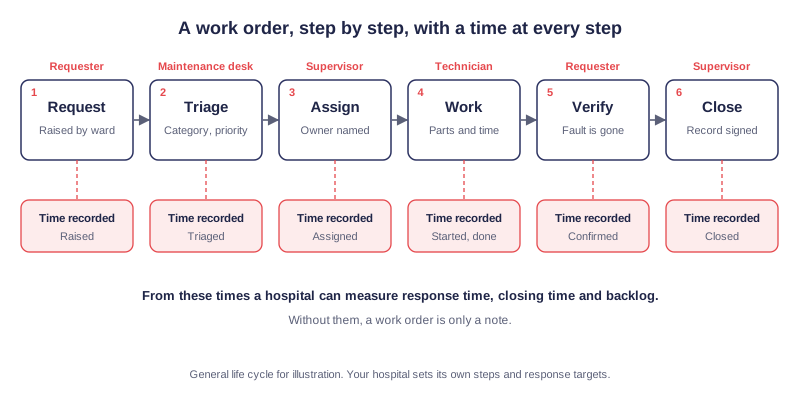
The anatomy of a good work order
A work order does not need many fields. It needs the right ones, filled in by the right person at the right time. Here is the minimum a hospital engineer would ask for.
- Who raised it and where. The requester's name and the exact location, by block, floor and room. A request that says "ward" is not a request.
- What is wrong. A short description and a category, such as electrical, plumbing or air conditioning, so the right team sees it first.
- How urgent. A priority that the hospital defines. A power fault in the ICU or the operating theatre, a medical gas leak and a lift stuck with a patient inside are life safety events. A loose door handle is not. Your engineer and your management decide the response targets, and they should be written down.
- Who owns it. A named technician, a contractor or an equipment maker, with the time of assignment.
- What was done. The work performed, spare parts used and the time taken, entered by the technician.
- Who confirmed it. The requester's confirmation, or the supervisor's if the requester cannot be reached, with the time of closure.
Cost is the seventh field, and the one most often skipped. When parts and contractor charges are attached to the work order, the hospital can see which department and which location cost the most to maintain, and which equipment is worth replacing. Spare parts that are held in stock belong in the Inventory & Supply Chain module, and the link between the part used and the stock record is where a good system saves time.
Which requests go to whom
A hospital maintenance team is rarely one team. Electrical and plumbing work may be done by in house staff. Lifts, generators and central air conditioning are usually under an annual maintenance contract with a specialist firm. Medical equipment belongs to the equipment maker or an authorised service agent. Fire systems have their own inspection regime. A work order system that sends every request to the same inbox will fail, so the category must lead to an owner. Our guide to biomedical equipment and asset tracking explains the common contract types for equipment.
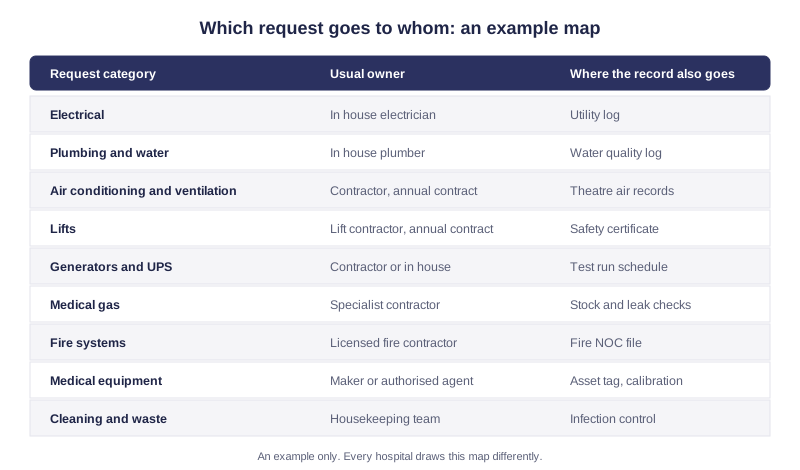
The boundary with housekeeping deserves a clear rule. A spill or a blocked drain that needs cleaning goes to the cleaning team through the Housekeeping entry of the support module. A cracked floor tile that harbours dirt goes to maintenance. A clinical machine that has failed goes to the equipment owner and is recorded against its tag in the asset register. Writing these rules once, on one page, saves a hundred arguments.
The utilities that cannot fail
Some maintenance requests are different in kind, because the patient cannot wait. A hospital depends on a few utilities whose failure stops care within minutes.
Electric power comes first. A hospital needs a backup source that starts automatically when the grid fails, and the critical areas, such as the operating theatres, the ICU, the emergency room and the dialysis unit, need power with no gap. Generator test runs, fuel stock and battery checks are routine tasks that deserve a schedule and a record. Water comes next. A dialysis unit depends on treated water, and the Dialysis Unit module page covers that department. Medical gases, oxygen above all, need leak checks and stock records. Ventilation and air conditioning in operating theatres affect infection risk, so theatre air handling needs a maintenance schedule that the Operating Theatre module team can see.
The CDC has published guidance on environmental infection control in healthcare facilities, including water systems and ventilation, and the landing page is linked in the sources below. Use it as a reference for the principles, and use your engineer's judgement for your building.
Fire safety is the other category where records matter as much as equipment. Fire licences are issued by the state fire services, and renewal periods differ across states, so there is no national interval. Our guide to the hospital fire safety NOC in India covers the legal background and what NABH asks for on top of the certificate. For maintenance teams the practical point is simple: every extinguisher refill, every alarm test and every pump run belongs on a schedule with a record, and every failure belongs on a work order.
Corrective work and planned work
Hospitals perform two kinds of maintenance. Corrective maintenance is the repair after something breaks. Preventive maintenance is the planned inspection, cleaning, lubrication or replacement that stops it from breaking. A hospital that does only the first one lives in a cycle of emergencies, and the cost of a breakdown at night is always higher than the cost of a planned visit in the day.
The work order is the common record for both. A corrective work order starts with a complaint. A preventive work order starts with a calendar. If the system supports recurring orders, the generator test run becomes a task that appears every week with the technician's name, instead of a duty that depends on someone's memory. If the system does not support recurring orders, the hospital needs another way of scheduling planned work and a rule that every planned job produces a work order record when it is done. We ask you to test this in the demo because the sidebar shows only one entry, and the answer tells you how far the module goes.
NABH accreditation looks at both kinds. The standards published by NABH have a chapter on facility management and safety, and an assessor reading it will ask how the hospital inspects and maintains its building and utilities, how problems are reported and fixed, and what evidence exists. The standards document is linked in the sources below, and our guide to NABH accreditation software shows how the audit tools of the ERP fit together.
What the numbers should tell you
A work order system pays for itself in the reports it makes possible. A hospital director should be able to see, in a few minutes, how many requests are open and how old the oldest one is, the average time to close by category, the locations and equipment with repeat requests, the cost by department and the requests that missed the response target. These are simple counts and averages, and they change conversations. A head of engineering who shows that four of the last six breakdowns involved the same compressor wins the budget for replacement. A ward in charge who sees that her unit raised the most requests may find that the cause is a design fault in the room.
The ERP also has an analytics group in its sidebar, the Analytics & Command Centre module, where hospital leaders look at operations. Ask the presenter whether work order counts and ageing can appear there. Serious failures should also flow into incident reporting, which sits in the Compliance & Quality module, so that a patient safety event caused by a utility failure is investigated and not only repaired. Technician rosters and attendance connect to the HR & Payroll module, and contractor visits should be recorded against work orders so that an annual contract can be reviewed against the visits it delivered.
Questions to ask any vendor before you buy
These questions work for OneCity and for every competitor. The right test is a live screen, not a slide.
- Show me a request raised from a ward by a nurse, and how the maintenance desk sees it.
- Show me how a request is assigned to an in house technician and to an outside contractor.
- Show me how priority is set, and how a life safety request is made to stand out.
- Show me a closed work order with times, parts and the requester's confirmation.
- Show me how a recurring job, such as a weekly generator test, is scheduled and how a missed one appears.
- Show me the list of open work orders sorted by age, and the average time to close by category.
- Show me how an equipment breakdown links to the asset register, and how a spare part used links to stock.
- Show me how I can export every work order if we ever change systems.
A small hospital may start with a handful of categories and a few technicians, and that is a sound start. Choose a system that will still serve you when you add a second building, a contractor for every utility and a quality team that wants monthly reports.
What this page does and does not claim
The Work Orders entry comes from a screen capture of the OneCity ERP demo tenant taken on 30 September 2026. We did not describe fields we have not seen. The anatomy of a work order, the categories and the owners above are general operating guidance from our experience of how hospitals work, and each hospital should adapt them. The statement about fire licences comes from our fire safety guide and applies state by state. OneCity does not hold a NABH certificate for its software, and nothing on this page says that using the module makes a hospital NABH compliant.
If you want to see the module on your own requests, book a demo and bring a month of your maintenance slips with you. The pricing page shows the plans, and we suggest confirming module inclusion for your plan in writing.
Frequently asked questions
What does the Facility & Maintenance module include in OneCity?
In the capture of the OneCity ERP sidebar that we reviewed, the group shows one entry: Work Orders. Ask for a live walkthrough, including whether recurring and planned jobs are supported, because the depth of each screen changes as the product grows.
What is a work order in hospital maintenance?
A work order is a written request for a repair or a planned maintenance task. It records the location, the problem, the priority, the person responsible, the work done, the time taken and the confirmation of closure, so the hospital has evidence and can measure its response.
What is the difference between corrective and preventive maintenance?
Corrective maintenance is the repair that follows a breakdown. Preventive maintenance is the planned inspection or servicing that aims to stop the breakdown. A hospital needs both, and the work order is the common record for each.
Does NABH require maintenance software?
No. NABH expects a hospital to inspect and maintain its building and utilities, to fix problems and to show records. Complete paper registers also meet the evidence need. Software makes the records easier to keep current, search and report.
Who issues the fire safety certificate for a hospital?
Fire licences and no objection certificates are issued by the state fire services under state rules, and renewal periods differ across states. Check your state's requirement. Our fire safety guide explains the background and what NABH asks for on top of the certificate.
How is Facility & Maintenance different from Asset Management?
Asset Management keeps the register of equipment, its depreciation and its calibration dates. Facility & Maintenance handles work orders for repairs and planned upkeep of the building and its utilities, and a breakdown of a registered machine links the two.
Is the Facility & Maintenance module included in the free or Starter plan?
We do not state plan inclusion for this module on this page. Check the pricing page and ask for written confirmation of which modules your plan includes before you sign.
Sources
NABH Hospital Accreditation Standards, 6th edition, January 2025 (portal.nabh.co). CDC, Guidelines for Environmental Infection Control in Health Care Facilities, landing page (cdc.gov). The ERP sidebar entry comes from a screen capture of the OneCity demo tenant dated 30 September 2026. The OneCity fire safety guide and biomedical equipment guide were also used. This page is general information. It is not legal, safety or engineering advice, and standards and state rules change, so confirm every point with your engineer, NABH and the relevant authority.
Related reading
Bring a month of maintenance slips to a live demo and see them as work orders.
Book a demo