
Compliance · Telemedicine · 14 min read
Telemedicine Practice Guidelines 2020: What Hospitals Must Actually Do
India's Telemedicine Practice Guidelines cannot be used to sign a pathology or radiology report remotely, cannot cover a surgical or invasive procedure, and restrict which medicines a doctor can prescribe based on whether the consultation is a first visit or a follow-up. These aren't edge cases, they're the specific, government-clarified boundaries of what telemedicine software is legally allowed to support in an Indian hospital, and most vendor marketing pages don't mention any of them. What follows is the practical detail: what the guidelines actually cover, what they explicitly forbid once a real clarification request forced the regulator to say so in writing, and what a hospital's software needs to enforce structurally rather than leave to a doctor's judgment in the middle of a busy consultation queue.
What the guidelines actually are
The Telemedicine Practice Guidelines were released on 25 March 2020 by India's Ministry of Health and Family Welfare, prepared by the Board of Governors of the then Medical Council of India in partnership with NITI Aayog, arriving right as COVID-19 forced consultations online overnight. They were added as Appendix 5 to the existing Indian Medical Council (Professional Conduct, Etiquette and Ethics) Regulations, 2002, not a standalone Act, but a binding appendix to the rules every Registered Medical Practitioner already operates under. The National Medical Commission, which replaced the Medical Council of India, now administers them under the NMC Act 2019.
The scope is specific: text, audio, and video consultations between a Registered Medical Practitioner and a patient, covering the doctor-patient relationship, consent, and prescribing rules. What the guidelines don't cover matters just as much as what they do, research, continuing medical education, and anything outside direct patient consultation fall outside their scope entirely.
What's explicitly not allowed
Two restrictions get missed constantly, because they only became fully clear through a specific clarification rather than the original text alone. A doctor filed an RTI asking the NMC directly whether a Registered Medical Practitioner can sign pathology and radiology lab reports via remote authentication without physical presence and supervision. The NMC's written response was unambiguous: no. The guidelines do not extend to remote-operated invasive or surgical procedures either, reinforcing that direct physical supervision remains mandatory for anything beyond consultation. For a hospital running a lab or diagnostic centre with doctors reviewing reports from home, this is a direct compliance exposure, a workflow that feels like a natural extension of telemedicine convenience but sits outside what the guidelines actually permit.
List O, List A, List B, and what can never be prescribed
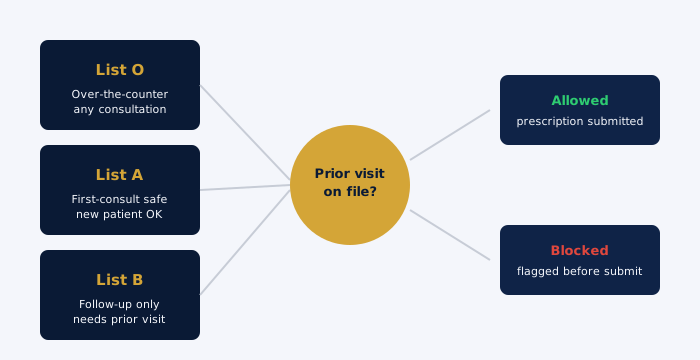
The guidelines categorise medicines into three lists based on what a teleconsultation can safely support. List O covers over-the-counter medications suitable for any consultation. List A covers medicines a doctor can prescribe confidently on a first-ever teleconsultation with a patient. List B covers medicines that require an existing doctor-patient relationship, prescribable only as a follow-up to a prior in-person or teleconsultation, not on a cold first contact. A separate prohibited list sits outside all three: medicines the guidelines block from telemedicine prescription entirely, regardless of consultation history, covering categories like narcotic and psychotropic substances that carry independent restrictions under the NDPS Act.
| List | What it covers | When it can be prescribed |
|---|---|---|
| List O | Over-the-counter medicines | Any consultation, including first contact |
| List A | Common first-consult medicines | First teleconsultation is sufficient |
| List B | Follow-up medicines | Only after an established doctor-patient relationship |
| Prohibited list | Narcotics, psychotropics, and other restricted categories | Never via telemedicine |
Consent, documentation, and the doctor-patient relationship
The guidelines require explicit patient consent before a teleconsultation proceeds, implied consent is acceptable when the patient initiates contact, but a hospital-initiated outreach programme needs documented, affirmative consent. Every teleconsultation needs a contemporaneous record: date, time, mode of consultation, and the clinical notes a doctor would keep for any in-person visit. The guidelines also require a doctor to establish and verify a patient's identity before prescribing, a gap that's easy to overlook in a rushed video call and exactly the kind of thing hospital software should enforce as a mandatory field, not an optional one.
Where DPDP and telemedicine data rules overlap
The guidelines predate the DPDP Act 2023 by three years, and the two now sit on top of each other for any hospital running telemedicine. The DPDP Act's consent, purpose-limitation, and breach-notification requirements apply fully to teleconsultation records, video call data, and any health information captured during a remote visit, a hospital can't treat telemedicine data as exempt from the same data-protection obligations that apply to an in-person patient file. Storage location, retention period, and who within the hospital can access a teleconsultation recording all need the same DPDP-compliant handling as the rest of the patient record.
What hospital software needs to enforce, not just record
The gap between "the guidelines exist" and "the software actually enforces them" is where most compliance risk lives. A system needs to flag when a prescribed medicine falls in List B but the patient has no prior consultation on file, not leave that check to the doctor's memory mid-consultation. It needs to make explicit consent a required field before a teleconsultation session can be documented as complete, not an assumed checkbox. It needs to keep lab report authentication as a physical-presence-only workflow, structurally separate from the teleconsultation module, so a busy radiologist can't accidentally sign a report through the wrong screen. And it needs an audit trail, consultation mode, consent timestamp, prescribed medicines against their list category, that would satisfy an NMC or state medical council inquiry without the hospital having to reconstruct it after the fact, since reconstruction under pressure is where gaps in an otherwise reasonable process tend to surface.
What actually goes wrong in practice
The most common real-world failure isn't a doctor deliberately ignoring the rules, it's software that doesn't distinguish between consultation types clearly enough for a doctor to notice the boundary in the moment. A doctor reviewing a queue of teleconsultations back-to-back, with no visual flag showing "this patient has no prior visit on file," can prescribe a List B medicine without realising the guidelines don't permit it on a first contact. A hospital running telemedicine through a generic video-call tool bolted onto an unrelated records system loses the audit trail entirely, since consent and consultation notes live in a different place than the video session itself. And a lab that lets radiologists review images from home, without a structural block on report sign-off, is one convenient login away from the exact scenario the NMC's RTI response ruled out.
Text, audio, and video, do the rules differ by mode?
The guidelines recognise all three communication modes as valid telemedicine, but they don't treat them identically in practice. A video consultation gives a doctor visual cues closest to an in-person visit, and most hospitals treat it as the default mode for anything beyond a routine follow-up. Audio-only consultations are permitted but carry a higher documentation burden, since there's no visual record of the exchange if a dispute arises later. Text-based consultation, chat or messaging, is the mode most likely to produce ambiguity about what was actually asked and answered, which is exactly why the guidelines lean so heavily on contemporaneous documentation regardless of mode: the record has to stand on its own, since the mode itself won't reconstruct the conversation later.
Interstate and cross-border telemedicine
A Registered Medical Practitioner is licensed by a specific State Medical Council, and the guidelines don't create a blanket right to practice across every state simply because a consultation happens over video. A doctor registered in one state consulting a patient physically located in another operates within a genuine grey area that the guidelines don't resolve cleanly, most legal commentary treats the doctor's home-state registration as controlling, but a hospital running telemedicine across multiple states should not assume this is fully settled. Cross-border consultations, where the patient is outside India entirely, sit even further outside what the guidelines were written to address, since they were drafted for practice within the Indian regulatory system.
Documentation as the actual liability shield
In a malpractice dispute, an in-person consultation has a physical chart, often with a nurse's note and vitals taken by staff who can be asked what they observed. A teleconsultation has none of that unless the software captures it deliberately. The guidelines make clear that the standard of care expected from a doctor doesn't drop simply because the consultation happened remotely, meaning the documentation burden, if anything, increases, since there's less physical evidence to fall back on if a patient later disputes what was discussed or prescribed. A consultation record that only shows "video call, prescription issued" with no timestamp, no consent record, and no note on what symptoms were reported is a genuine liability gap, not a convenience.
What state medical councils actually enforce
The National Medical Commission sets the guidelines, but day-to-day enforcement runs through State Medical Councils, which handle individual complaints against Registered Medical Practitioners. A patient complaint about a telemedicine prescription, wrong medicine, wrong list category, no proper consent, gets investigated at the state level, using the national guidelines as the standard being checked against. This matters for a hospital operating telemedicine across several states: the specific consultation and prescription records a doctor is expected to produce during a state council inquiry are exactly the records the underlying software either makes trivial to pull up, or forces someone to reconstruct manually under time pressure.
Common mistakes hospitals make rolling out telemedicine
The most frequent mistake is treating telemedicine as a bolt-on video-call feature rather than a clinical workflow with its own documentation requirements, a hospital that adds Zoom or a generic video tool without tying it to the patient record ends up with consultation data that lives nowhere useful. A second is not training doctors on the List O/A/B distinction specifically, assuming clinical judgment alone will catch a first-consult-only medicine being prescribed to a new patient. A third is applying the same consent process used for in-person visits without adapting it for remote consultation, missing the guidelines' specific requirement for consent appropriate to the telemedicine context. And a fourth, common in labs specifically, is allowing remote report review without a structural block on final sign-off, exactly the gap the NMC's RTI clarification closes, and the one most likely to go unnoticed until an actual complaint forces the question.
Telemedicine for psychiatry and mental health specifically
Mental health consultation was one of the earliest and most active use cases for telemedicine in India, and NIMHANS published its own Telenursing Practice Guidelines in 2020 specifically to work alongside the national Telemedicine Practice Guidelines for psychiatric and mental health contexts. This matters for a hospital running a psychiatry department through telemedicine: the base guidelines' consent and prescribing rules still apply in full, and the List B restriction on follow-up-only medicines is particularly relevant given how much of psychiatric prescribing involves ongoing medication management rather than first-consult prescriptions. A hospital's telemedicine and psychiatry module need to reflect this overlap rather than treat psychiatric teleconsultation as identical to a general OPD video call.
Building the audit trail a state council inquiry would actually accept
If a State Medical Council opens an inquiry into a specific teleconsultation, the records that hold up aren't a general note that a consultation happened, they're a specific, timestamped sequence: when consent was captured and in what form, what mode the consultation used, what symptoms and history were recorded, what was prescribed and against which medication list, and whether the patient had a prior consultation on file justifying a List B prescription. Software that captures this as a single unstructured note field makes reconstructing that sequence painful under time pressure. Software that captures each element as its own structured field makes producing that record, on request, a matter of minutes rather than days of manually piecing together what happened from a video call log and a doctor's memory.
Where this connects to the rest of your compliance work
For the product side of what's described here, see our telemedicine software page. Hospitals running psychiatric teleconsultation specifically should also review our guide to the Mental Healthcare Act 2017, since consent and documentation requirements overlap directly. And since telemedicine relies on properly credentialed doctors, our piece on why hospitals should mandate HPR IDs covers the credentialing side of this in more depth.
Related compliance pages: fire safety NOC, HAI surveillance, blood bank management, and emergency and casualty.
How OneCity's telemedicine module handles this
OneCity's telemedicine module ties consultation type, consent capture, and prescription list-checking into a single workflow rather than three disconnected steps, a List B medicine prescribed without a prior consultation on file gets flagged before submission, not discovered later. Lab report sign-off stays structurally separate in the radiology and RIS/PACS module, requiring the same physical-presence workflow as an in-person report regardless of how the images arrived. All consultation and consent records fall under the same DPDP Act 2023 data-handling rules as the rest of the patient record, and the underlying patient identity ties back to UHID-based patient registration, so a teleconsultation and an in-person visit for the same patient are never two disconnected records.
For hospitals building out a broader digital health stack, our guides on ABDM and ABHA integration and NMC compliance cover the adjacent registration and practice requirements telemedicine sits alongside.
Telemedicine incentives and where the ecosystem is heading
Telemedicine adoption in India accelerated far beyond what the 2020 guidelines' drafters likely anticipated, driven initially by pandemic necessity and sustained since by genuine patient demand for reduced travel and faster access, particularly in tier-2 and tier-3 cities where specialist availability is thin. Insurance recognition followed close behind the guidelines themselves, IRDAI recognised teleconsultation for insurance claims within months of the original release, which meant telemedicine stopped being a convenience add-on and became billable, reimbursable clinical activity. That shift is exactly why the compliance details matter more now than they did in the guidelines' first year: a teleconsultation that generates an insurance claim, and later gets audited, needs the same documentation rigour as any other billed clinical encounter, not the lighter-touch record-keeping that might have been tolerable when telemedicine was still a stopgap measure.
A draft update to the regulatory framework, the Registered Medical Practitioner (Professional Conduct) Regulations, has been circulating to eventually replace the 2002 regulations the current Telemedicine Practice Guidelines sit under as an appendix. Until that draft is formally notified, the 2020 guidelines as written, including the List O/A/B structure and the RTI-clarified restrictions, remain the operative standard. Hospital software built around today's rules should be designed to accommodate updated prescribing lists or scope changes without a full rebuild, since telemedicine regulation in India is still a comparatively young framework likely to see further refinement as adoption scales.
Frequently Asked Questions
Can a doctor sign lab reports remotely under the Telemedicine Practice Guidelines?
No. The National Medical Commission clarified in an RTI response that the guidelines do not permit remote authentication of pathology and radiology reports without the doctor's physical presence and supervision.
Can telemedicine be used for surgical or invasive procedures?
No. The guidelines explicitly exclude remotely operated invasive or surgical procedures from their scope. Telemedicine under these rules covers consultation, not hands-on intervention.
What are List O, A, and B medications?
They're the three medication categories the guidelines define for prescribing via teleconsultation: List O covers over-the-counter medicines, List A covers medicines safe to prescribe on a first consult, and List B covers medicines that can be prescribed only as a follow-up to an in-person consultation. A separate prohibited list cannot be prescribed via telemedicine at all.
Do the guidelines apply to all systems of medicine?
The 2020 Telemedicine Practice Guidelines specifically govern registered medical practitioners under allopathic regulation. They were issued as an appendix to the existing Professional Conduct regulations for RMPs, not as a standalone law covering every system of medicine.
Sources and further reading
The Telemedicine Practice Guidelines themselves are published by the Ministry of Health and Family Welfare. The clarification on remote lab report authentication is drawn from reporting on the doctor's RTI response from the NMC.
Regulatory interpretation can evolve, confirm current requirements with the National Medical Commission or your state medical council before relying on any single source, including this one. Given how much of the compliance detail here comes from an RTI clarification rather than the original guideline text, it's also worth confirming with a state council directly whenever a specific workflow, remote report sign-off, cross-border consultation, a borderline prescribing decision, isn't unambiguously covered by what's publicly documented.
Run telemedicine consultations with the consent and prescribing checks built in
Free up to 5 doctors. No card, no setup fee.
Book a demo See pricing