
Compliance · ABDM · Staff Credentialing · 13 min read
Why Hospitals, Not Individual Doctors, Should Drive HPR Registration
Registration on India's Healthcare Professionals Registry is voluntary for individual doctors — but a hospital's management can make it a condition of employment or credentialing for its own staff, and that's exactly how most real-world adoption actually happens. Leaving HPR registration to each doctor's personal initiative means a hospital ends up with a partially-registered medical staff, incomplete credential verification, and gaps in exactly the digital infrastructure that TPAs and insurers are progressively starting to require for claims. Here's the case for treating this as a hospital HR decision, not an individual one, and what actually changes once it's mandated — covering the practical rollout mechanics, not just the policy argument for why it matters.
What HPR actually verifies, and why it's more than an ID number
The Healthcare Professionals Registry is a national, government-maintained directory covering doctors across every system of medicine, dentists, nurses, and allied health professionals. What makes it meaningfully different from a doctor simply listing their own credentials somewhere is the double verification built into the process: identity is established through Aadhaar-based KYC, and — separately — qualifications and medical council registration are checked directly against the relevant council's own records, whether that's the National Medical Commission, a State Medical Council, the Dental Council, or the Indian Nursing Council. This converts a credential claim into a government-verified fact, which is exactly the kind of verification a hospital's own credentialing process benefits from, rather than relying solely on documents a new hire submits at onboarding.
Why this is a hospital decision, not just a personal one
HPR's own published guidance is explicit that enrollment is voluntary for the individual professional, but adds directly that hospital management may take a decision on making their healthcare professionals register on the registry. This distinction matters enormously in practice: a hospital that treats HPR as "something doctors can do if they want to" ends up with fragmented adoption — the digitally engaged younger staff register, senior consultants with heavier patient loads deprioritise it, and the hospital's overall digital-health readiness ends up dependent on individual enthusiasm rather than institutional policy. A hospital that instead makes HPR registration part of onboarding and ongoing credentialing gets complete, verified coverage across its medical staff as a matter of process, not chance.
What a hospital actually gains from full-staff HPR coverage
Insurance and TPA claim processing is where this stops being an abstract digital-health goal and becomes a real operational concern — TPAs and insurers are progressively requiring HPR ID for claim approval, meaning a hospital with incomplete staff coverage risks claims friction tied specifically to which doctor treated a given patient. Credentialing itself gets simpler: a doctor's council registration, verified once by the council through HPR, becomes a standing verified fact the hospital's own credentialing file can reference rather than re-verify from scratch. And for hospitals pursuing state empanelment or scheme participation, HPR registration across medical staff is increasingly assumed infrastructure — most state health initiatives now expect it as part of what "digitally ready" actually means for an empanelled facility.
| Without hospital mandate | With hospital mandate |
|---|---|
| Partial, uneven staff coverage | Complete coverage as a hiring/credentialing standard |
| Claims friction tied to unregistered doctors | Consistent claims processing across all staff |
| Credentialing relies on submitted documents alone | Council-verified credentials on file |
| Empanelment readiness uncertain | Staff-side digital readiness already in place |
The registration process, from an administrator's rollout view
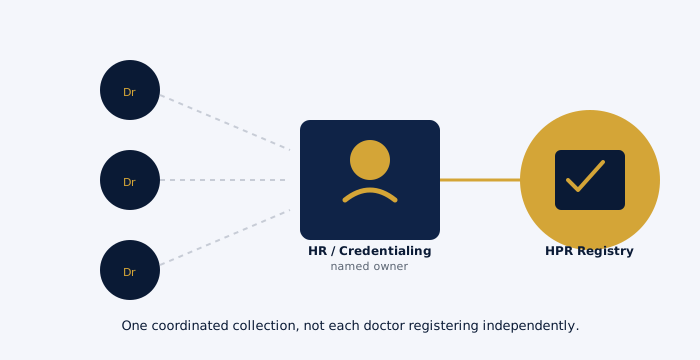
Each staff member registers individually — HPR credentials aren't transferable or bulk-created by the hospital on a doctor's behalf — but a hospital can meaningfully structure the rollout. The process needs a mobile number linked to Aadhaar for OTP-based verification, medical council registration details including the specific council name and registration number, degree certificate information, a passport-style photograph, and current place of work. Enrollment itself takes roughly 20-30 minutes per person when documents are ready, with council verification typically following within 3-10 working days depending on application volume and the specific council's processing pace. A hospital rolling this out across an entire medical staff benefits from collecting these documents centrally before the registration window opens, rather than leaving each doctor to locate their own paperwork independently.
Common friction points when rolling this out across a full staff
Senior consultants with the heaviest patient loads are often the least likely to prioritise a 20-30 minute administrative task on their own initiative, which is precisely the group a mandated policy needs to reach rather than exempt informally. Doctors without an Aadhaar-linked mobile number face a slower path — a driving licence is accepted as an alternative KYC document, but carries a higher rejection rate and a slower verification flow, so identifying which staff fall into this category early avoids a late rollout surprise. And practitioners registered with a council but not currently in active clinical practice can still enrol, which matters for hospitals maintaining a bench of visiting or on-call consultants who aren't full-time staff but still need credential verification on file.
Making HPR registration part of the hiring process, not a retrofit
The cleanest way to reach full staff coverage is building HPR registration into the hiring pipeline itself rather than retrofitting it onto an existing medical staff after the fact. A new doctor's offer letter or onboarding checklist can include HPR enrollment as a standard step alongside other joining formalities — background verification, council registration confirmation, employment paperwork — so it becomes routine administrative process rather than a separate initiative someone has to remember to launch. For an existing staff of fifty or a hundred doctors, retrofitting requires active outreach and follow-up; for every doctor hired from this point forward, it costs nothing extra to make it simply part of joining.
Allied health professionals: the next wave of HPR coverage
Current HPR enrollment is centred on doctors, but the registry is explicitly designed to expand to other categories of healthcare professionals over time, including nurses, physiotherapists, lab technicians, dieticians, and other allied health workers. A hospital planning its HPR rollout purely around physicians risks having to repeat the entire administrative exercise — document collection, staff communication, verification follow-up — again for each subsequent professional category as it comes online, rather than building a rollout process once that scales naturally as new categories become eligible. Treating HPR as an ongoing credentialing infrastructure decision, not a one-time doctor-specific project, positions a hospital to absorb each new professional category with a repeatable process rather than a fresh initiative each time.
What "verified" actually protects a hospital from
A credential fraud or misrepresentation risk — a practitioner overstating a qualification, or a council registration that's lapsed without the hospital's HR team noticing — is exactly the failure mode HPR's council-level verification is designed to catch before it becomes the hospital's problem. A hospital relying solely on documents submitted at hiring is trusting the accuracy of what was submitted, potentially years before it's ever independently re-checked. A hospital requiring HPR registration gets the benefit of council verification happening at enrollment and remaining checkable going forward, shifting part of the ongoing credential-accuracy burden from the hospital's own HR diligence onto a system explicitly built to verify it against the authoritative source.
How this connects to the facility side
HPR registers the individual professional; the Health Facility Registry registers the hospital itself as a distinct entity. A hospital pursuing full ABDM readiness needs both sides complete — a registered facility with unregistered staff, or fully-registered staff at a facility that never completed its own HFR registration, both leave the digital-health picture incomplete. Treating these as one coordinated rollout, rather than two separate initiatives handled by different people at different times, avoids the common outcome where one side gets finished and the other quietly never does.
What multi-location hospital groups should plan for differently
A hospital group operating across several cities faces a scale problem similar to facility-level ABDM registration: each doctor at each location needs individual HPR enrollment, and a group with a thousand-doctor combined medical staff across ten hospitals is coordinating a thousand individual registrations, not one bulk action. Centralising the rollout — a single HR-led initiative coordinating document collection and follow-up across every location, rather than each hospital administrator running an independent, uncoordinated effort — avoids the predictable outcome where some locations reach full staff coverage quickly and others lag by months, creating exactly the uneven digital-readiness picture a unified group should be trying to avoid across its own network.
The cost of doing nothing
There's no direct financial penalty today for a hospital that simply never addresses HPR registration among its staff — it remains, at the individual level, entirely voluntary. But the cost shows up indirectly and compounds over time: claims friction with TPAs that increasingly expect HPR-linked documentation, empanelment applications that take longer or face additional scrutiny when staff-side digital readiness is incomplete, and a widening gap between a hospital's own digital-health maturity and where state and national programmes are heading. None of this is an emergency on any single day, which is exactly why it's easy to deprioritise — right up until a specific claim gets flagged, or a specific empanelment review asks a question the hospital isn't prepared to answer quickly.
Where staff credentialing connects to other compliance areas
Staff credentialing connects to several other compliance areas a hospital already tracks. NABH accreditation reviews staff qualification documentation as part of its broader assessment, and our guide to Telemedicine Practice Guidelines covers exactly where verified doctor credentials matter most in remote consultations. For hospitals also tracking medico-legal documentation, MLC register software covers how credentialed staff tie into that record. And if you're planning a hospital-wide rollout that includes staff credentialing as one phase among several, our guide to realistic ERP implementation timelines covers how to sequence it. See the full module list for how staff credentialing ties into HR more broadly.
How OneCity's Founder thinks about this, in practice
Building a hospital ERP that touches ABDM registration across both facilities and individual professionals means seeing the same pattern repeat across every hospital we work with: the technical registration process itself is rarely the hard part — it's coordination across a busy medical staff with limited administrative bandwidth to spare. The hospitals that get full HPR coverage quickly are consistently the ones that treat it as a defined project with a named owner and a deadline, not an ongoing "please register when you get a chance" request that competes with clinical priorities and predictably loses. That operational lesson applies well beyond HPR specifically — it's the same reason FSSAI renewal deadlines and AERB equipment licences get missed at hospitals without a clear owner, and met reliably at hospitals that assign one.
Vendor selection: does your clinic software actually use HPR IDs?
A hospital that completes staff-wide HPR registration but runs clinic or hospital software that doesn't reference those IDs anywhere in its actual workflow has done half the job. The point of registering isn't the certificate — it's that every ABDM-linked prescription, discharge summary, or digital record carries a verified professional identity by default. Before assuming this is handled, it's worth asking a vendor directly: does a doctor's HPR ID get pulled into every record they create automatically, or does someone have to manually attach it each time, if the software supports it at all? Software that treats HPR as a checkbox in a settings page, disconnected from the actual documents doctors generate daily, gives a hospital compliance in name without the operational benefit HPR registration was actually designed to provide.
A simple rollout checklist for hospital administrators
A short, practical sequence works better than an open-ended "everyone please register" announcement. Start by identifying which staff already have HPR IDs, since some may have registered independently already, and duplicate outreach wastes goodwill. Assign one named owner for the rollout — typically HR or a credentialing lead — rather than leaving it distributed across department heads with no single point of accountability. Collect the required documents centrally in advance: Aadhaar-linked mobile numbers, council registration numbers, degree details, and photographs, ideally gathered during a single coordinated request rather than several scattered follow-ups. Set a real deadline, communicated clearly, rather than an indefinite "at your convenience" window that predictably slips. And track completion centrally, the same way any other credentialing requirement gets tracked, rather than trusting informal confirmation that "most people have probably done it by now."
Measuring success beyond a completion percentage
A hospital tracking HPR rollout purely by completion percentage — "80% of doctors registered" — misses a real distinction worth tracking separately: enrolled versus verified. A doctor who has submitted an application but hasn't yet cleared council verification isn't functionally equivalent to one who has, particularly for claims processing purposes where a TPA or insurer may specifically require verified status, not just an application in progress. Software and administrative tracking should distinguish these two states clearly, since reporting "90% enrolled" while a meaningful share sit in unverified limbo overstates actual digital-health readiness in exactly the way that matters most when a real empanelment review or claims audit asks the question directly.
What hospital software should actually track
Given that HPR IDs attach to individual staff members rather than the hospital as a whole, software needs to track registration and verification status per person, not as a single facility-wide checkbox. It should flag which staff members are unregistered so a credentialing team can follow up specifically, rather than assuming coverage is complete because the hospital "did an HPR drive" at some point in the past. It should tie a doctor's HPR ID directly to the prescriptions and records that ID authenticates, so every ABDM-linked document carries a real, verified professional identity by default rather than as an afterthought added later. And for hospitals onboarding new consultants regularly, HPR status should be a standard field in the credentialing checklist, checked at hire rather than discovered as a gap months into employment.
How OneCity ties HPR into staff credentialing
OneCity's HR and payroll module tracks each staff member's HPR ID and verification status as part of the same credentialing record used for council registration and employment documentation, rather than as a separate ABDM-only data point disconnected from HR. This ties directly into the ABDM national stack module, so a doctor's verified HPR identity flows into the prescriptions and records their OPD consultations generate, matching the same facility-level tracking covered in our guide to why tier-2/3 hospitals need a unified ERP.
Frequently asked questions
Is HPR registration mandatory for doctors in India?
No, enrollment in the Healthcare Professionals Registry is voluntary at the individual level. However, a hospital's management can make HPR registration a condition of employment or credentialing for its own staff, which is how most adoption actually happens in practice.
Does HPR replace a doctor's medical council registration?
No. HPR does not replace existing registration issued by respective councils such as the National Medical Commission or state medical councils. It brings that verified data onto a unified national digital platform alongside it.
How long does HPR verification take?
Enrollment itself takes 20-30 minutes if documents are ready. Verification against council records typically takes a further 3-10 working days depending on application volume and the specific council involved.
What documents does a doctor need for HPR registration?
A mobile number linked to Aadhaar for OTP verification, medical council registration details including council name and registration number, degree certificate details, a passport-style photograph, and current place of work.
Sources and further reading
Voluntary enrollment status and verification detail are drawn directly from the official Healthcare Professionals Registry FAQ published by the National Health Authority, cross-checked against an independent HPR registration walkthrough. Registration requirements can change — confirm current process details directly on the HPR portal before starting a hospital-wide rollout.
Track HPR status across your entire medical staff, not just individual doctors
Free up to 5 doctors. No card, no setup fee.
Book a demo See pricing