
Compliance · Emergency Department · 13 min read
MLC Register Software for Indian Hospitals: What It Actually Has to Do
Every casualty department in India registers medico-legal cases. Almost none of them do it in a system built for the job. Most still run on a bound paper register, a duplicate carbon-copy police intimation form, and institutional memory about which drawer the acknowledgment receipts are filed in. That gap between a legal duty every doctor already knows and the tools available to discharge it is what this article covers, what an MLC actually is under Indian law, where paper registers break down, and what medico-legal case software needs to capture to hold up in an NABH audit or a court summons three years later.
The stakes here aren't hypothetical for a tier-2/3 hospital. An MLC entry can end up read into evidence in a criminal trial years after the patient was discharged and long after anyone on staff remembers the case. A missing or contradictory MLC record doesn't just cost points on an NABH assessment, it can undermine the hospital's own credibility as a witness in a case where the treating doctor is called to testify. That's a very different bar than most hospital software modules are held to, and it's why this particular corner of the ERP deserves more scrutiny than a typical feature request.
What actually counts as an MLC
A medico-legal case is any case of injury, poisoning, or death where the circumstances suggest a police investigation may be needed to fix responsibility. It is a clinical judgment call made by the treating doctor, not a checkbox filled in by a clerk. Categories that consistently trigger MLC registration across Indian hospital protocols include road traffic accidents with grievous hurt, burns, suspected poisoning or drug overdose, physical assault, suspected sexual assault, unnatural deaths, and any "brought dead" case where foul play cannot be ruled out. A case can also be registered as an MLC days after admission if new findings change the clinical picture, the law does not require same-day registration, only that registration happens without unreasonable delay once suspicion arises.
This is the first place software design goes wrong. Systems that only let a case be flagged as MLC at the registration desk, on day one, don't match how MLCs actually arise. A patient admitted for a routine fracture can become an MLC on day three if the story doesn't add up. A hospital information system needs to let any treating doctor, not just the triage nurse, flag a case as medico-legal at any point in the stay, and that flag needs to timestamp itself against the real clinical record, not get backdated to admission.
The doctor's legal duties and the reporting timeline
Section 39 of the erstwhile Code of Criminal Procedure placed a duty on certain classes of people, including practising doctors in specific circumstances, to inform the nearest police station of particular categories of offences. That duty now sits under the Bharatiya Nagarik Suraksha Sanhita (BNSS), which replaced the CrPC as part of India's 2024 criminal law overhaul, alongside the Bharatiya Nyaya Sanhita (BNS) replacing the IPC. The underlying obligation is unchanged, the section numbers moved. This matters for software specifically: any MLC module still hard-coded to reference only IPC/CrPC section numbers in its printed forms or its help text is already citing law that no longer exists in that form, which is a real defect, not a cosmetic one.
Where death appears imminent, the treating doctor must arrange for a magistrate to record a dying declaration, a step with its own timing pressure that paper systems handle badly because nobody is tracking the clock on it. Where the case involves a minor and suspected abuse, the Protection of Children from Sexual Offences Act adds a mandatory reporting duty on top of the general MLC duty, this is not optional and does not wait for parental consent. None of this is exotic law. It's what every casualty medical officer in India already learns in training. The problem has never been that doctors don't know the rules; it's that the systems around them don't make following the rules the easy path.
Section 357C CrPC: free treatment is not optional, and it isn't linked to billing systems
Section 357C of the CrPC, again now carried forward under the BNSS framework, requires every hospital, public or private, to provide free first-aid and medical treatment to victims of specific offences, including acid attacks, rape, and gang rape, and mandates that the case be reported to police immediately. This creates a direct collision with hospital billing software: if the ERP's billing module doesn't recognise a Section 357C flag, the front desk can end up asking a sexual assault survivor for a deposit or an insurance card before treatment, which is both a legal violation and precisely the kind of institutional failure that ends up in the newspapers and in front of a State Human Rights Commission. Billing and MLC registration cannot be separate systems that don't talk to each other. The moment a case is flagged under Section 357C, the billing engine needs to zero out the encounter automatically, not rely on a duty clerk remembering to manually waive it.
Why the paper MLC register keeps failing audits
Talk to any NABH assessor who has reviewed an emergency department's medico-legal records and the same list of findings comes up. Handwriting that a second reader genuinely cannot decipher, which matters enormously if that entry is read out in court two years later. Entries made out of order because the register was in use at the nursing station and the correction had to be squeezed into a margin. Police acknowledgment receipts that exist somewhere in the hospital but not stapled to the case they belong to. No reliable way to prove an entry wasn't altered after the fact, since a paper register has no audit log, only the ink itself, and ink doesn't testify. And when a police officer or a court asks for every MLC linked to a specific accused, a specific vehicle registration number, or a specific date range, someone has to physically page through a bound register, because a paper log has no search function.
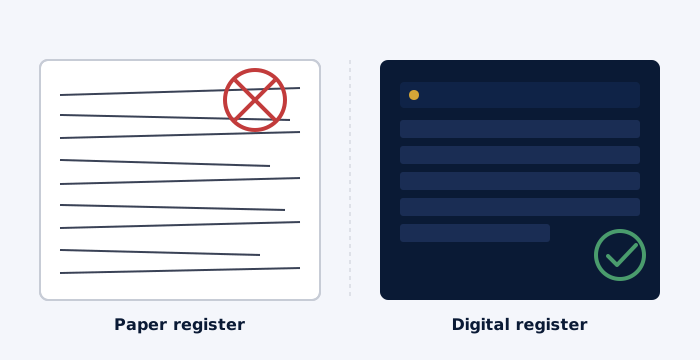
None of this reflects badly on the doctors and nurses filling the register in. A busy casualty department at 2am, one working pen, and a bound notebook is not a system failure of the staff, it's a system failure of the tooling they were handed. The fix is not "train people to write more neatly." The fix is removing the dependency on handwriting, memory, and a single physical object entirely.
What MLC register software actually needs to track
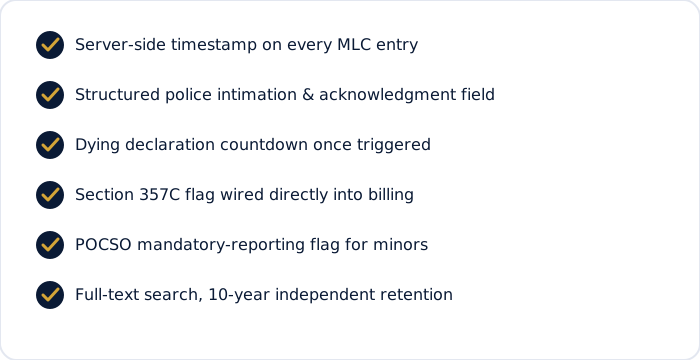
A digital MLC register earns its place in the ERP only if it does more than move the same paper form onto a screen. At minimum it needs: a server-side timestamp on every entry that the user cannot edit, separate from any date the user types in, so a late-registered MLC still shows exactly when it was actually entered. A structured field for which police station was informed, by whom, at what time, and by what mode, phone, in person, or in-hospital liaison desk, with the acknowledgment reference number stored against that specific MLC, not filed separately. A dying-declaration flag that starts a visible countdown once triggered, rather than relying on someone remembering to call the magistrate's office. A dedicated Section 357C flag that is wired directly into the billing module so free treatment isn't a manual override anyone has to remember. A POCSO flag for cases involving minors that enforces the mandatory reporting step rather than leaving it as an optional checkbox. Full-text and structured search across every past MLC, by date range, by police station, by outcome, by treating doctor, because that search request will come, often years after discharge. And a retention rule that holds MLC records for a minimum of ten years independent of the hospital's general medical-record retention policy, since these documents carry evidentiary weight long after routine records would normally be purged.
Common mistakes hospitals make the first time they digitize this
The first mistake is treating the MLC flag as a one-time decision made at the registration desk. If the software only exposes "mark as MLC" during the initial registration screen, every late-onset MLC, the fracture patient whose story falls apart on day three, the poisoning case that only becomes clear once a toxicology result comes back, has nowhere to go except back to a paper workaround, which defeats the entire point of digitizing in the first place. The flag needs to be available from any clinical note, at any point in the encounter, to any treating doctor with the right role, not locked to one screen and one moment in time.
The second is storing the police acknowledgment as a scanned image attached to the record instead of as structured, searchable data. A scanned PDF satisfies an auditor who is looking at one specific file. It does nothing for the far more common real request, which is "show me every MLC we reported to this police station in the last six months" or "pull every MLC linked to this FIR number," because you can't run a query against a picture of a piece of paper. The acknowledgment reference, the police station name, the officer's name, and the date and mode of contact need to be their own fields, not text buried inside an attachment.
The third mistake is assuming brought-dead cases don't need the same rigor as live patients, because there's no ongoing treatment to document. Every brought-dead case where foul play can't immediately be ruled out is still an MLC, still needs police intimation, and still needs the same timestamped, structured record, arguably more so, since the patient can't later corroborate or contradict anything in the chart. Software that only surfaces the MLC workflow inside an active-patient encounter screen will quietly miss this category unless it's been explicitly designed to catch it.
The fourth is rolling out training to the day shift and assuming night shift will pick it up informally. MLC volume in most Indian casualty departments skews heavily toward night and weekend hours, assault cases, road traffic accidents, and alcohol-related presentations cluster there, which is exactly when senior supervision is thinnest and exactly the shift most likely to fall back on the old paper register the moment the new screen feels unfamiliar under pressure. Night shift needs its own dedicated training session, not a handover briefing from the day team.
Who should own the MLC module inside the hospital
This sits awkwardly between three departments in most hospitals, and that ambiguity is itself a risk. Casualty medical officers own the clinical judgment call of what counts as an MLC and the actual documentation. The quality or NABH cell owns the audit trail and needs to be able to pull reports without going through IT each time. Hospital administration or legal counsel owns the Section 357C billing linkage and needs visibility when a free-treatment flag has been applied, both to confirm it was applied correctly and to make sure it wasn't applied to inflate a discount elsewhere. The cleanest structure gives casualty full write access at the point of care, gives the quality cell read-and-report access without needing a ticket raised to IT, and routes every Section 357C flag as a notification to the billing supervisor so nobody discovers the exemption after the fact during a monthly reconciliation. Deciding this ownership on paper, before go-live, avoids the far more common failure mode of the module technically working while nobody is actually accountable for reviewing what it's capturing.
What we see in hospitals with an MLC register on paper
Working with hospitals on medico-legal case documentation, the gap is rarely a lack of policy, most hospitals already keep an MLC register on paper. It's that the paper register and the actual clinical record live in two different places, and that mismatch is usually only discovered when a court or an inquiry asks for both and they don't line up.
How OneCity handles this in the emergency department and patient registration modules
OneCity's ED triage and MLC module lets any treating doctor flag a case as medico-legal at the point of triage or later in the stay, with a server-side timestamp that can't be backdated and a structured police-intimation record, station, officer, mode of contact, acknowledgment reference, attached directly to the case, not stored as a separate paper trail. The patient registration module's survivor-flagging feature carries the Section 357C flag from the point of registration straight through to billing, so a sexual assault or acid attack survivor is never asked for payment before treatment because a front-desk clerk didn't know the rule applied. Both modules sit inside the same patient registration and emergency department workflows already covered under OneCity's NABH 6th edition compliance mapping, and MLC entries feed the same incident reporting trail an NABH assessor will actually ask to see. None of this requires a separate product or a separate login, it's the same patient record, the same encounter, with the legal obligations built into the workflow instead of bolted on as a parallel paper process.
Related compliance and module pages: emergency and casualty management software, blood bank management, fire safety NOC, and HAI surveillance.
Rolling this out in a tier-2/3 hospital without disrupting casualty on day one
The realistic rollout order matters more than the feature list. Start by digitising new MLC entries only, don't attempt to backfill the paper register's history in week one, since that's a data-entry project, not a compliance project, and trying to do both at once is how these rollouts stall. Keep the paper register running in parallel for the first two to four weeks as a physical backup while casualty staff get comfortable with the screen flow, and reconcile the two daily rather than trusting a big-bang cutover. Train the night shift specifically and separately from the day shift; MLC volume skews heavily toward night and weekend casualty traffic, exactly when senior supervision is thinnest, so that's where a confusing new screen does the most damage if the training was rushed. And involve your NABH quality cell before go-live, not after, the fields your MLC software captures should be the same fields your last internal audit flagged as weak, not a generic template a vendor shipped for every hospital regardless of what your last assessment actually found.
Related reading on adjacent compliance areas that intersect with MLC handling: how PCPNDT Act compliance creates its own reporting duties around illegal sex-determination cases, how the Mental Healthcare Act 2017 changes documentation requirements for self-harm cases that often arrive as MLCs, and how a properly maintained NDPS narcotics register intersects with poisoning and overdose MLCs where controlled substances are involved. If you're preparing for an assessment more broadly, OneCity's NABH readiness self-assessment covers where MLC documentation typically loses points during a survey.
Frequently asked questions
Is MLC registration required if the patient or family refuses?
Yes. The decision to register a case as an MLC rests with the treating doctor's clinical judgment, not on patient or family consent. Emergency treatment is given first regardless of MLC status, and registration follows once the patient is stabilised.
Can a case become an MLC days after admission?
Yes. A case can be registered as an MLC at any point during treatment, even if it wasn't flagged on arrival, if new findings or history suggest legal implications. MLC software needs to support late registration without breaking the audit trail on the original admission record.
What is the difference between an MLC and an FIR?
An MLC is a medical document created by the treating doctor; an FIR is a police document. They're linked but separate, the hospital's duty ends at accurate MLC documentation and police intimation, not at filing or pursuing the FIR itself.
How long must MLC records be retained?
Medico-legal training material commonly puts safe custody of these documents at a minimum of 10 years, since MLC reports can be summoned as evidence long after discharge. Hospital software should apply a retention hold to MLC records independent of routine medical-record purge cycles.
Does MLC software need direct police portal integration?
Not for basic compliance. What matters more for an NABH audit or a court summons years later is a complete internal record, who intimated which police station, when, the acknowledgment reference, and how that ties to the discharge summary. Direct portal integration is a bonus, not a substitute for that internal record.
Sources and further reading
Background on MLC identification, documentation, and retention practice drawn in part from the National Health Systems Resource Centre's medico-legal guidelines for medical officers, and on the transition from IPC/CrPC section numbers to the Bharatiya Nyaya Sanhita and Bharatiya Nagarik Suraksha Sanhita from a medical-education explainer on MLC and the new criminal codes. Hospitals should confirm current section references against the official gazetted text before updating internal forms.
See the ED triage and MLC module in your own casualty workflow
Free up to 5 doctors. No card, no setup fee.
Book a demo See pricing