
Compliance · Quality · Billing & Insurance
NABH Accreditation Software for Hospitals
NABH-accredited hospitals get expedited PM-JAY empanelment processing and, in many states, a package rate premium of 10-15% above the standard NHA rate as a quality incentive, a real revenue difference for any hospital with meaningful PMJAY patient volume, not just a quality badge. Getting there means passing assessment across roughly 600 parameters spanning patient safety, clinical documentation, and quality indicators. Software can't earn accreditation for you, but it can remove the manual paperwork burden that delays most applications.
What NABH actually assesses
The National Accreditation Board for Hospitals & Healthcare Providers is a constituent board of the Quality Council of India, formed as the principal hospital accreditation body in the country. Hospitals are assessed across roughly 600 parameters spanning patient rights and education, access and continuity of care, care of patients, management of medication, infection control, continuous quality improvement, and facility management and safety. NABH standards apply not just to large tertiary hospitals but to eye care organisations, standalone clinics, diagnostic laboratories, Ayush facilities, and even the software vendors supplying HIS/EMR systems to them.
The assessment covers ten functional areas, and each one maps to specific documentation a hospital must produce on demand. Patient rights, infection control, medication management, facility management, human resource management, information management, quality improvement, responsibilities of management, access and continuity of care, and care of patients. For a 50-bed tier-2 hospital, the most common stumbling blocks are infection control documentation (hand hygiene audit logs, antibiotic stewardship records, and HAI surveillance data that assessors cross-check against reported rates) and information management (structured discharge summaries, consent records with timestamps, and audit trails showing who accessed which record and when). A hospital that keeps these in paper registers rather than a searchable digital system spends the first two days of an assessment just locating the files the assessor asked for on day one.
The assessment covers ten functional areas, and each one maps to specific documentation a hospital must produce on demand. Patient rights, infection control, medication management, facility management, human resource management, information management, quality improvement, responsibilities of management, access and continuity of care, and care of patients. For a 50-bed tier-2 hospital, the most common stumbling blocks are infection control documentation (hand hygiene audit logs, antibiotic stewardship records, and HAI surveillance data that assessors cross-check against reported rates) and information management (structured discharge summaries, consent records with timestamps, and audit trails showing who accessed which record and when). A hospital that keeps these in paper registers rather than a searchable digital system spends the first two days of an assessment just locating the files the assessor asked for on day one.
Entry-Level, Progressive, and Full, which stage fits your hospital
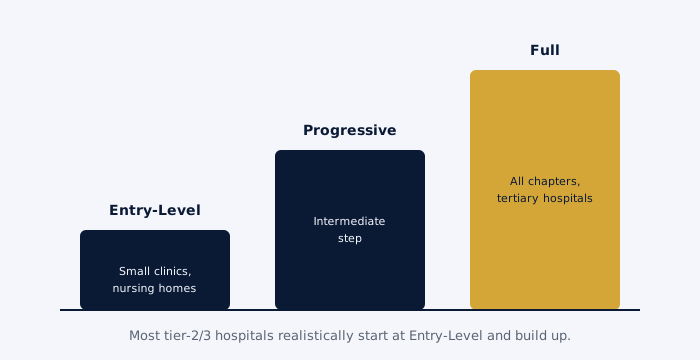
NABH operates multiple accreditation tracks rather than one single standard every hospital must meet identically. Entry-Level accreditation (NABH-EHCO) is designed for smaller facilities and single or few-doctor clinics working toward full standards over time. Progressive-Level sits as an intermediate step for hospitals building toward complete compliance. Full Accreditation covers the complete standard across all chapters and is what most tertiary and multi-specialty hospitals ultimately pursue. A tier-2/3 hospital evaluating NABH for the first time should generally plan for Entry-Level as the realistic starting point, not attempt Full Accreditation before the underlying documentation and quality processes are in place to support it.
The real financial case for accreditation
Beyond the reputational value, NABH accreditation carries a concrete financial argument that's easy to underweight. Accredited hospitals get expedited PM-JAY empanelment processing, and in many states, qualify for a package rate premium of 10-15% above the standard NHA rate specifically as a quality incentive, for a hospital with high PMJAY patient volume, that premium compounds into substantial additional revenue over a year. Most third-party administrators and private insurers in India, including major names like Star Health, HDFC ERGO, and United Health, recognise NABH accreditation as a quality signal and may offer cashless empanelment preference or reduced claim scrutiny for accredited facilities. This is the argument that often gets a hospital's finance team, not just its quality team, invested in pursuing accreditation.
| What NABH accreditation provides | Why it matters |
|---|---|
| Expedited PM-JAY empanelment | Faster access to scheme patient volume |
| 10-15% package rate premium (many states) | Direct, compounding revenue impact |
| TPA/insurer preference | Reduced claim scrutiny, cashless preference |
| ISQua international recognition | Relevant for medical tourism patients |
International recognition and medical tourism relevance
NABH holds Institutional Status with the International Society for Quality in Health Care (ISQua), meaning its standards are internationally peer-reviewed and benchmarked against global accreditation frameworks. For hospitals serving international patients specifically, this matters concretely, medical tourism facilities benefit from ISQua-recognised accreditation because international patients and their insurers actively look for that recognition when choosing where to seek treatment abroad, rather than accepting an unfamiliar domestic standard at face value.
ISQua (the International Society for Quality in Health Care) has accredited NABH as a standards-setting body, which means a NABH certificate is recognised by insurers and referral networks in the Middle East, South-East Asia, and parts of Africa where Indian hospitals draw medical tourism patients. For a hospital in Kochi, Hyderabad, or Chennai actively pursuing international patient volume, NABH accreditation is not optional, it is the credential travel facilitators and embassy medical desks check before adding a hospital to their referral list. Without it, a hospital competes on price alone against accredited competitors who can charge a premium precisely because they carry the certificate.
ISQua (the International Society for Quality in Health Care) has accredited NABH as a standards-setting body, which means a NABH certificate is recognised by insurers and referral networks in the Middle East, South-East Asia, and parts of Africa where Indian hospitals draw medical tourism patients. For a hospital in Kochi, Hyderabad, or Chennai actively pursuing international patient volume, NABH accreditation is not optional, it is the credential travel facilitators and embassy medical desks check before adding a hospital to their referral list. Without it, a hospital competes on price alone against accredited competitors who can charge a premium precisely because they carry the certificate.
What actually delays a NABH application
The most common reason a NABH application stalls isn't a genuine gap in clinical quality, it's incomplete or inconsistent documentation across the specific parameters assessors check. A hospital that maintains excellent clinical outcomes but tracks quality indicators on paper, spread across different departments with no consolidated view, struggles to produce the coherent documentation trail an assessor expects during a site visit. Consent forms scattered across paper files, infection-control data that exists but isn't aggregated into the specific indicator format NABH reviews, and incident reports that were filed but never analysed for pattern trends are the recurring, avoidable gaps, not clinical failures, documentation failures.
The single most common reason an application stalls is incomplete documentation of quality indicators. NABH expects at least six months of continuous data on indicators like hospital-acquired infection rates, medication error rates, patient fall rates, unplanned readmission within 30 days, and surgical site infection rates. A hospital that starts collecting these only after filing the application has built in a six-month delay before the first assessor visit can even be scheduled. The second most common delay is the gap between what a hospital says its SOPs are and what its records show it actually does. An assessor who finds a hand hygiene SOP on the wall but no audit log showing compliance checks will flag that as a non-conformity, and enough non-conformities push the assessment into a reassessment cycle that adds another three to six months.
The single most common reason an application stalls is incomplete documentation of quality indicators. NABH expects at least six months of continuous data on indicators like hospital-acquired infection rates, medication error rates, patient fall rates, unplanned readmission within 30 days, and surgical site infection rates. A hospital that starts collecting these only after filing the application has built in a six-month delay before the first assessor visit can even be scheduled. The second most common delay is the gap between what a hospital says its SOPs are and what its records show it actually does. An assessor who finds a hand hygiene SOP on the wall but no audit log showing compliance checks will flag that as a non-conformity, and enough non-conformities push the assessment into a reassessment cycle that adds another three to six months.
What NABH-ready software actually needs to do
Genuinely NABH-ready software goes beyond storing records digitally, it needs to track quality indicators in the specific structured format NABH assessors review, not just as free-text clinical notes. It needs digital consent capture with audit-ready timestamps and signatures, since consent documentation is one of the most heavily scrutinised areas across NABH chapters. It needs incident reporting that aggregates into pattern analysis automatically, rather than filing individual reports that never get reviewed collectively. And it needs a documentation trail spanning admission through discharge that an assessor can review coherently in one place, instead of piecing together records from separate paper and digital systems that were never designed to talk to each other.
Concretely, the software must produce a structured discharge summary that includes diagnosis (ICD-10 coded), procedures performed, medications at discharge, follow-up instructions, and the treating doctor's digital signature or authenticated identifier. It must log every consent with a timestamp and the staff member who obtained it, not a batch-uploaded scan of a signed form. It must track clinical quality indicators automatically from the data already being entered during care, not from a separate spreadsheet maintained by the quality department after the fact. Incident reporting (medication errors, patient falls, needle-stick injuries) must be captured in a system that generates trend reports an assessor can review on screen, not in an email thread between the nursing supervisor and the quality manager. If the software cannot produce these outputs from its own database without manual compilation, the hospital is paying for a system that creates NABH prep work rather than eliminating it.
Concretely, the software must produce a structured discharge summary that includes diagnosis (ICD-10 coded), procedures performed, medications at discharge, follow-up instructions, and the treating doctor's digital signature or authenticated identifier. It must log every consent with a timestamp and the staff member who obtained it, not a batch-uploaded scan of a signed form. It must track clinical quality indicators automatically from the data already being entered during care, not from a separate spreadsheet maintained by the quality department after the fact. Incident reporting (medication errors, patient falls, needle-stick injuries) must be captured in a system that generates trend reports an assessor can review on screen, not in an email thread between the nursing supervisor and the quality manager. If the software cannot produce these outputs from its own database without manual compilation, the hospital is paying for a system that creates NABH prep work rather than eliminating it.
Where NABH accreditation connects elsewhere
NABH accreditation also intersects with several specific compliance areas covered elsewhere on our site. Our guide to MLC register software covers medico-legal documentation standards NABH assessors review, and Clinical Establishments Act registration is often a prerequisite step before pursuing accreditation. Hospitals with blood bank operations should also see our guide to e-RaktKosh compliance, which NABH assessors increasingly expect as part of blood bank standards review.
Related compliance and module pages: fire safety NOC, HAI surveillance and infection control, blood bank management, and emergency and casualty management.
How OneCity supports NABH readiness
OneCity's NABH quality module tracks quality indicators in NABH's own structured format, alongside incident reporting that aggregates automatically rather than sitting as isolated filed reports. Consent capture ties directly into IPD admissions and operating theatre workflows, so documentation exists at the point of care rather than being reconstructed afterward. For hospitals evaluating accreditation readiness specifically, our NABH readiness quiz gives a quick starting assessment, and our guide on what your hospital ERP must do for NABH 6th edition covers the detailed chapter-by-chapter requirements.
For hospitals also pursuing PMJAY empanelment specifically, see our guide to PMJAY empanelment and claims software, which covers how accreditation status and claims processing connect in practice.
What NABH accreditation actually costs a hospital
NABH publishes its fee schedule on nabh.co, and the direct fees are not the expensive part. For a hospital with up to 100 beds, the application fee for Entry-Level certification is around INR 1 lakh, and for Full Accreditation it ranges from INR 2 to 4 lakh depending on bed count and scope. The assessment team's travel and stay are charged separately, typically INR 50,000 to 1.5 lakh depending on location. These are one-time costs on a three-year cycle.
The real cost is internal: the quality coordinator's time (most hospitals either hire one or reassign an existing senior nurse), the six to twelve months of documentation buildup before the first assessment, the mock assessments that surface gaps, and the software or system changes needed to produce the records assessors expect. A hospital that starts with paper registers and no structured discharge summary format is looking at 8 to 14 months of preparation. A hospital that already runs a system generating coded discharge summaries, timestamped consents, and indicator dashboards can compress that to 3 to 5 months. That preparation-time difference is where the software investment pays for itself, not in the NABH fee, but in the months of salary, consultant, and opportunity cost it removes from the accreditation timeline.
What NABH accreditation actually costs a hospital
NABH publishes its fee schedule on nabh.co, and the direct fees are not the expensive part. For a hospital with up to 100 beds, the application fee for Entry-Level certification is around INR 1 lakh, and for Full Accreditation it ranges from INR 2 to 4 lakh depending on bed count and scope. The assessment team's travel and stay are charged separately, typically INR 50,000 to 1.5 lakh depending on location. These are one-time costs on a three-year cycle.
The real cost is internal: the quality coordinator's time (most hospitals either hire one or reassign an existing senior nurse), the six to twelve months of documentation buildup before the first assessment, the mock assessments that surface gaps, and the software or system changes needed to produce the records assessors expect. A hospital that starts with paper registers and no structured discharge summary format is looking at 8 to 14 months of preparation. A hospital that already runs a system generating coded discharge summaries, timestamped consents, and indicator dashboards can compress that to 3 to 5 months. That preparation-time difference is where the software investment pays for itself, not in the NABH fee, but in the months of salary, consultant, and opportunity cost it removes from the accreditation timeline.
Frequently asked questions
Does NABH accreditation actually increase hospital revenue?
Indirectly, yes. NABH-accredited hospitals receive expedited PM-JAY empanelment processing, and in many states qualify for a package rate premium of 10-15% above the standard NHA rate as a quality incentive, a meaningful revenue difference for hospitals with real PMJAY patient volume.
What are the stages of NABH accreditation?
NABH operates Entry-Level accreditation for smaller facilities, Progressive-Level as an intermediate step, and Full Accreditation, the complete standard covering all chapters. Smaller clinics and nursing homes typically start with Entry-Level (also called NABH-EHCO) before progressing further.
Does NABH accreditation help with medical tourism?
Yes. NABH holds Institutional Status with the International Society for Quality in Health Care (ISQua), meaning its standards are internationally peer-reviewed. International patients and their insurers often specifically look for ISQua-recognised accreditation when choosing a facility abroad.
Can hospital software alone guarantee NABH accreditation?
No software can guarantee accreditation, that depends on clinical practice, infrastructure, and staff. What software can do is provide the documentation, quality indicator tracking, and audit trails NABH assessors actually inspect, removing the manual paperwork burden that often delays applications.
Sources and further reading
Accreditation stages and scope are drawn from NABH's own published history and structure, and the PM-JAY package rate premium detail is drawn from an NABH accreditation checklist covering the financial incentive structure. Confirm current accreditation requirements and any state-specific package rate premium directly with NABH or your state's PMJAY nodal agency.
Build the documentation trail NABH assessors actually check
Free up to 5 doctors. No card, no setup fee.
Book a demo See pricing