
Compliance · Hospital Operations · 13 min read
Clinical Establishment Registration: What Your Hospital Software Actually Needs to Track
Most content about clinical establishment registration in India is written by firms that want to file the paperwork for you. That's a legitimate service, but it stops at the certificate. Nobody is writing about what happens in month eleven of a twelve-month provisional registration, or four years and seven months into a five-year permanent one, when the renewal clock is the thing quietly running out in the background of a busy tier-2/3 hospital with no dedicated compliance officer watching it. This article covers what the Clinical Establishments Act actually requires, why the timeline trips up hospitals that treat registration as a one-time task, and what your hospital software needs to do so that never happens.
This matters more for tier-2/3 facilities than it does for large accredited hospital chains, precisely because smaller hospitals are less likely to have a dedicated compliance officer whose entire job is tracking exactly this kind of deadline. A 400-bed tertiary hospital with a full legal and quality department will catch a renewal deadline through sheer institutional redundancy, several people would notice independently. A 40-bed tier-2/3 hospital running on a lean administrative team does not have that redundancy, which is exactly why the deadline needs to live inside a system rather than inside any one person's memory.
What the Clinical Establishments Act actually requires
The Clinical Establishments (Registration and Regulation) Act, 2010 requires registration for hospitals, nursing homes, clinics, diagnostic and pathology laboratories, and maternity homes, across every recognised system of medicine, allopathy, Ayurveda, Yoga and Naturopathy, Homoeopathy, Siddha, and Unani. It applies regardless of size, which means a single-doctor clinic and a 200-bed multi-specialty hospital sit under the same basic registration duty, even though the infrastructure and staffing standards they're assessed against scale with what they offer. The Act sets minimum standards across four areas that a registering authority will actually inspect: infrastructure, built-up area, layout, waiting areas, consultation rooms; personnel, staffing patterns and the qualifications of medical and paramedical staff; equipment appropriate to the services offered; and record-keeping, which is where hospital software becomes directly relevant rather than a side concern.
Healthcare is a state subject under India's constitutional division of powers, which is why this Act has not been adopted uniformly, it's currently in force in roughly nineteen states and union territories, and a sitting Rajya Sabha MP has publicly pushed for the central government to make it mandatory nationwide, noting that even Delhi has not adopted it. States that haven't adopted the central Act generally run their own equivalent legislation instead, not a regulatory vacuum. This is the detail that trips up hospital groups expanding across state lines: assuming the compliance checklist that worked in one state transfers directly to the next.
The two-stage timeline that catches hospitals off guard
Registration isn't a single event, it's a two-stage process with two different clocks. Once an application and its supporting details are submitted, the authority issues a provisional registration certificate, valid for up to twelve months, which allows the establishment to legally begin or continue operating while it works toward full compliance with the prescribed standards. During that provisional window, the hospital needs to actually meet the infrastructure, staffing, equipment, and record-keeping standards it declared, because the next step is verification, not a formality. Once verified, a permanent registration certificate is issued, valid for five years from the date of issue. Renewal has to be filed within six months before that five-year certificate expires, not on the expiry date itself, and not after.
The failure pattern is predictable. A hospital tracks the provisional-to-permanent transition carefully, because it's new, it's urgent, and everyone remembers it happened recently. Then, once the permanent certificate is issued, the five-year renewal clock gets filed away with the certificate itself, often literally, in a folder, and nobody owns watching it, because five years is long enough for the person who handled the original registration to have left, been promoted, or simply forgotten which drawer the certificate is in. The renewal window opening six months before expiry then passes unnoticed until the certificate itself expires, at which point the hospital is technically operating an unregistered facility.
A practical six-months-before-expiry checklist looks like this: confirm the current staffing pattern still matches what's on file with the registering authority, since staff turnover over a five-year certificate period is near-universal; pull an up-to-date equipment inventory, especially for any service line added since the last registration; verify infrastructure hasn't changed in ways that need to be declared, such as an added ward or a converted consultation room; and gather the record-keeping evidence an inspector will actually ask for rather than assembling it reactively once the inspection is scheduled. Hospitals that keep this data live inside their ERP throughout the five-year period can produce this checklist in an afternoon. Hospitals that don't are effectively starting a data-reconstruction project under time pressure, competing with the same administrative staff who are also running daily operations.
What the registering authority actually inspects, in practice
The four standards the Act names, infrastructure, personnel, equipment, and record-keeping, sound abstract until an inspection is actually scheduled, at which point they turn into a very concrete document request. On infrastructure, expect scrutiny of built-up area against the number of beds declared, layout and adequacy of waiting areas and consultation rooms, and increasingly, linkage to biomedical waste handling arrangements under the separate BMW Rules framework, since an inspector reviewing infrastructure will usually ask how waste segregation and disposal is handled as part of the same visit. On personnel, the authority wants proof, not a declaration, registration certificates for every doctor with the National Medical Commission or the relevant state medical council, verifiable qualifications for nursing and paramedical staff, and a current staffing pattern that actually matches the services the hospital claims to offer, not a historical org chart nobody has updated. On equipment, the standard scales to what the hospital actually provides: a facility offering radiology services needs to show the equipment and the operator qualifications for it; a facility that doesn't offer that service isn't assessed against it. On record-keeping, this is where hospital software stops being a nice-to-have and becomes the actual evidence, an authority conducting a renewal inspection is, in effect, asking to see the hospital's patient records, staffing records, and equipment logs, and a hospital running on a mix of paper registers and disconnected spreadsheets will spend the week before an inspection assembling documents that a properly configured ERP could produce as a single export.
The national, state, and district digital registry, and why it matters beyond compliance
The Act mandates a digital registry of clinical establishments at the National, State, and District level, intended to give the public visibility into which facilities are legitimately registered and to help authorities monitor compliance and renewal status across their jurisdiction. For an individual hospital, appearing correctly and currently in that registry is not just a legal checkbox, it's increasingly a trust signal that referring physicians, insurers, and patients themselves can check independently of anything the hospital says about itself. A hospital whose registration has technically lapsed but which continues operating under an expired certificate is not just exposed to penalties; it's vulnerable to a referring doctor, an empanelment auditor, or even a patient's family looking up the registry directly and finding a mismatch between what the hospital claims and what the state's own records show. Keeping registration status current isn't only about avoiding an inspector's visit, it's about not being contradicted by a public record you don't control.
State-by-state variation: why a national checklist doesn't work
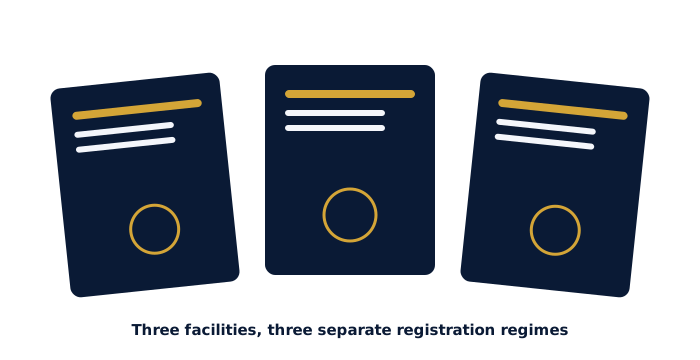
Karnataka is a useful worked example precisely because it does not run under the central Act at all, it has its own legislation, the Karnataka Private Medical Establishments (KPME) Act, with its own registration portal and its own renewal cadence, separate from the national Clinical Establishments Act framework entirely. A hospital group operating in Bengaluru and also expanding into a state that has adopted the central Act cannot run one compliance calendar for both facilities; the trigger dates, the renewal windows, and even the department responsible for approval differ. OneCity's own KPME registration guide covers the Karnataka-specific process in detail for exactly this reason, state-specific compliance content that a generic national article can't responsibly cover in the same depth.
This matters operationally for any hospital group with facilities in more than one state, including several of the markets OneCity serves, Bengaluru, Lucknow, Jaipur, and Patna each sit under different state-level registration regimes, and a hospital ERP that hard-codes a single national renewal rule will quietly get at least one of those facilities wrong.
Why registration lapses even at well-run hospitals
It rarely happens through negligence. It happens because the certificate is a physical or PDF artifact, filed once and then invisible to daily operations, while the hospital's actual attention is consumed by patient care, staffing, and billing, the things the ERP surfaces every single day. A renewal deadline that lives only in a certificate folder is competing for attention against dashboards that update in real time, and it loses. The consequence isn't abstract: operating without valid registration is treated as an illegal activity under the Act, carrying penalties that range from fines to forced closure, and a lapsed registration can also stall empanelment renewals with insurers or government schemes that require current registration as a due-diligence condition, creating a second, delayed consequence months after the actual lapse, when a claim gets rejected or an empanelment renewal stalls for reasons that trace back to a certificate nobody was watching.
What your hospital software should track automatically
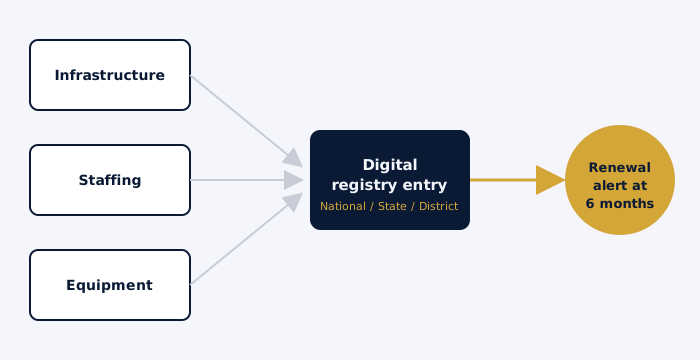
The fix isn't a better filing cabinet, it's making registration status a living record inside the same system that already tracks everything else the Act requires evidence of. Concretely, that means: the provisional and permanent certificate numbers, issuing authority, and both issue and expiry dates stored as structured fields, not as an attached scan nobody queries. An automatic alert that fires at the start of the six-month renewal window, not a static reminder someone has to remember to set. Direct linkage to the infrastructure, staffing, and equipment records the Act actually inspects, bed count, department list, staff qualifications and registrations, equipment inventory, so that renewal isn't a scramble to reconstruct data that already exists somewhere else in the hospital's own ERP. A single view for hospital groups with multiple facilities across different states, showing each facility's specific registration regime, current status, and next deadline side by side, rather than one calendar that quietly assumes every location follows the same national rule. And an audit trail showing when the registration status was last verified against the actual physical inspection, since a certificate on file and a facility that currently meets the standard it was issued against are not automatically the same thing five years later.
Common mistakes hospitals make when treating this as a one-time paperwork exercise
The most common mistake is filing the certificate and closing the task, rather than opening a five-year (or twelve-month, for provisional status) tracked item with an owner and a review date. A close second is assuming the person who handled the original application will still be at the hospital when renewal comes due, in a tier-2/3 hospital with a small administrative team, staff turnover over a five-year period is the rule, not the exception, and institutional memory about a compliance deadline is not a substitute for a system record with an assigned owner. A third mistake, specific to hospital groups, is assuming a single compliance calendar covers every facility, when in practice each state-registered facility runs on its own clock and its own authority. And a fourth is treating the registration record as disconnected from the infrastructure and staffing data the Act actually inspects, when renewal comes due, hospitals that kept that data current in their own ERP can produce it in an afternoon, and hospitals that didn't spend weeks reconstructing bed counts and staff credentials from scratch.
Who should own this internally
In most tier-2/3 hospitals, this ends up as an unofficial responsibility of whoever handled the original registration, with no formal handover process when that person moves on. A cleaner structure assigns registration tracking to the same quality or NABH cell already responsible for accreditation readiness, since the underlying data, infrastructure, staffing, equipment, record-keeping, overlaps heavily with what an NABH assessment reviews. Hospital administration should hold a standing calendar reminder tied to the actual renewal window, not the expiry date, and that reminder should be a system-generated alert inside the hospital's own software rather than a personal calendar entry belonging to one individual. For multi-facility groups, a single compliance owner at the group level should have visibility across every facility's registration status, precisely because state-level variation means no single facility administrator has reason to know how another state's process works.
This ownership question gets harder, not easier, as a hospital group grows. A single-facility hospital can get away with informal tracking because one administrator genuinely can hold the whole picture in their head. A group expanding into a second or third city is now tracking multiple certificates, multiple renewal clocks, and potentially multiple distinct legal frameworks at once, exactly the point at which relying on individual memory stops being a minor risk and becomes a structural one. That's the point at which registration tracking needs to move from a personal responsibility to a system-level record with its own reporting line.
What we see across hospitals registering in different states
Working with hospitals across different states on their Clinical Establishments Act registration, the state-by-state variation is consistently the part that catches people off guard, a hospital administrator who has handled registration in one state reasonably assumes the next state's process looks similar, and it usually doesn't. That mismatch between expectation and the actual state-specific process is where registration delays most often start.
How OneCity handles this
OneCity's compliance mapping treats clinical establishment registration status as structured, queryable data rather than an attached PDF, linked directly to the same NABH quality module that already tracks infrastructure, staffing, and equipment records for accreditation purposes, because a well-run registration renewal and a well-run NABH assessment draw on almost exactly the same underlying facts about the hospital. Karnataka facilities get the state-specific KPME workflow covered in our dedicated KPME registration guide; hospitals in other states get their applicable state regime instead of a one-size-fits-all national assumption. This sits inside the same platform covering India compliance more broadly, alongside NABH 6th edition, and ties into patient registration records that reference the same facility-level data.
Related compliance pages: fire safety NOC, HAI surveillance and infection control, blood bank management, and emergency and casualty management.
For hospitals deciding between platforms, our guide to hospital ERP selection for tier-2/3 facilities covers where compliance tracking fits against the rest of the buying decision, and our piece on why tier-2/3 hospitals need a unified ERP makes the broader case for why registration status shouldn't live in a system separate from the operational data it depends on. If you're evaluating vendors more generally, how to choose hospital management software in India covers the wider selection criteria, and hospitals specifically in Karnataka may also find our Bengaluru-focused overview useful alongside the KPME guide.
Frequently asked questions
Is clinical establishment registration required for a single-doctor clinic?
Yes, in states where the Act or an equivalent state law applies. Registration requirements cover hospitals, nursing homes, clinics, and diagnostic centres regardless of size, including single-practitioner clinics.
What happens if provisional registration lapses before permanent registration is granted?
Operating without valid registration is treated as illegal and can lead to penalties, fines, or forced closure. Hospitals should apply for permanent registration well before the provisional certificate's validity period ends, rather than waiting until it lapses.
Does registration status affect PMJAY, CGHS, or insurance empanelment?
Empanelment processes for government schemes and insurers commonly require proof of current, valid registration as part of due diligence, so a lapsed certificate can stall or block empanelment renewal even if the hospital continues operating.
Is the registration process different in each state?
Yes. Healthcare is a state subject in India, so the central Act has been adopted by a subset of states and union territories, while other states, including Karnataka, run their own equivalent legislation with separate portals and requirements.
Do I need to re-register or amend my certificate if I add a new department or service line?
Generally yes. Since registration is assessed against declared infrastructure, staffing, and equipment for the services actually offered, adding a new service line, a radiology department, a dialysis unit, an ICU expansion, typically needs to be declared to the registering authority rather than left for the next full renewal cycle to catch up on.
Sources and further reading
Background on the Act's scope, two-stage registration timeline, and state-level adoption drawn in part from a legal requirements overview published by Corpzo, and from a summary of the Clinical Establishments Act 2010 published by Coverfox. Hospitals should confirm current requirements with their state's registering authority, since adoption and specific procedures vary by state.
Track registration, NABH readiness, and renewal deadlines in one place
Free up to 5 doctors. No card, no setup fee.
Book a demo See pricing