
Telemedicine · Compliance
Telemedicine Software for Indian Hospitals
A video call is not telemedicine software. India's Telemedicine Practice Guidelines require documented consent, consultation notes, and a specific prescribing check against medication lists that depend on whether a patient has an existing relationship with the doctor — none of which a generic video tool built for any industry has any awareness of. Telemedicine software that's actually built for Indian hospitals ties consultation, consent, and prescribing into one workflow, so compliance is structural, not left to a doctor's memory mid-consultation.
Why a bolted-on video tool creates compliance risk
Most hospitals that add telemedicine quickly reach for whatever video-call tool is convenient — a generic conferencing app with no connection to the hospital's own patient records. The problem surfaces later: consent captured verbally at the start of a call with no record of it, consultation notes that exist only in a doctor's memory or a scattered personal document, and a prescription written without any check against whether the medicine requires a prior in-person visit. None of this is a hypothetical risk — it's exactly the documentation gap a state medical council inquiry or an insurance claim audit looks for first.
What genuinely compliant telemedicine software does
Consent capture happens as a required, timestamped step before a consultation can be marked complete, not an assumed verbal exchange. Consultation notes get recorded in the same structured format used for an in-person OPD visit, tied to the same patient record rather than living in a separate telemedicine-only silo. Prescribing checks run automatically against medication list categories, flagging a follow-up-only medicine if the patient has no prior consultation on file, before the prescription can be submitted — not discovered afterward during a review.
| Generic video tool | Purpose-built telemedicine module |
|---|---|
| No connection to patient record | Same record as in-person visits |
| Consent assumed, not documented | Required, timestamped consent step |
| No prescribing safeguards | Automatic medication-list check |
| Fails on poor connectivity | Built offline-first for tier-2/3 bandwidth |
Built for tier-2/3 connectivity, not assumed fibre
A telemedicine tool designed and tested primarily on high-bandwidth urban connections tends to fail exactly where tier-2/3 hospitals need it most — a 2 Mbps link with intermittent drops. Software built offline-first degrades gracefully instead of failing outright, keeping consultation notes and prescribing data intact through a connectivity gap rather than losing the session entirely.
Specialty-specific considerations
Not every specialty uses telemedicine the same way. Psychiatric consultations lean heavily on ongoing medication management, where the follow-up-only prescribing category matters more than in general OPD telemedicine. A module that treats every consultation identically, regardless of specialty, misses this — psychiatry-specific telemedicine workflows need the same prescribing safeguards applied with particular attention to patients on long-term medication regimens.
Where telemedicine compliance connects elsewhere
Telemedicine compliance connects to several other areas covered in more depth elsewhere on our site. Our guide to the Mental Healthcare Act 2017 covers additional consent requirements specific to psychiatric teleconsultation, and our piece on why hospitals should mandate HPR IDs covers the credentialing verification that makes a teleconsultation record trustworthy in the first place. Patient data captured during a teleconsultation falls under the same DPDP Act 2023 obligations as any other patient record. For hospitals pursuing broader quality accreditation, NABH accreditation software covers how telemedicine documentation fits into that larger assessment. See the full module list and our pricing page for how telemedicine fits into the complete platform.
How OneCity's telemedicine module works
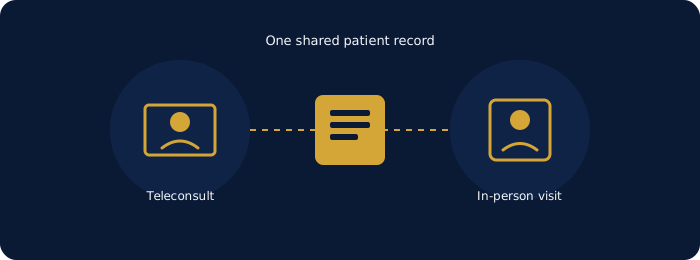
OneCity's telemedicine module ties consultation, consent, and prescribing checks into the same record used for OPD consultations, so a teleconsultation and an in-person visit for the same patient are never two disconnected histories. It's built on the same offline-first foundation as the rest of OneCity, and connects to the psychiatry module for specialty-specific prescribing patterns. For the full legal detail behind these requirements, see our guide to India's Telemedicine Practice Guidelines.
Frequently asked questions
Is a generic video-call tool enough for hospital telemedicine?
No. India's Telemedicine Practice Guidelines require documented consent, consultation notes, and prescribing checks against specific medication lists. A generic video tool has no connection to a patient's medical record and can't enforce these requirements, leaving the compliance burden entirely on the doctor's memory.
Can OneCity's telemedicine module work on a low-bandwidth connection?
Yes. OneCity is built offline-first for tier-2/3 hospital connectivity, and the telemedicine module is designed with the same constraint in mind, degrading gracefully on lower bandwidth rather than failing outright.
Does the software stop a doctor from prescribing a restricted medicine on a first consultation?
Yes. The module checks whether a prescribed medicine falls in a follow-up-only category and flags it if the patient has no prior consultation on file, before the prescription is submitted.
Sources and further reading
Telemedicine consultation and prescribing requirements referenced here are drawn from the Telemedicine Practice Guidelines published by the Ministry of Health and Family Welfare. Confirm current requirements with the National Medical Commission before relying on any secondary source.
See consultation, consent, and prescribing checks working together
Free up to 5 doctors. No card, no setup fee.
Book a demo See pricing