General information for hospital managers and patient relations teams. It is not legal advice. Data protection and telecom rules are changing, so confirm current requirements with qualified counsel. We reviewed the ERP sidebar on 30 September 2026 from a screen capture of the OneCity demo tenant.
What sits inside CRM & Feedback
In the OneCity ERP, the left sidebar lists the module groups in a fixed order, and CRM & Feedback follows Facility & Maintenance and comes before Telemedicine. It opens to three entries. We list them as they appear and describe the hospital job behind each one, without inventing screens we have not seen.
| Sidebar entry | The hospital job behind it | Ask to see in a demo |
|---|---|---|
| CRM Campaigns | Reaching groups of patients with reminders, follow up messages, camp invitations and package offers | How a patient list is built, how consent is checked before a send, and how replies and opt outs are recorded |
| Complaints | Receiving a complaint from any channel, assigning it, investigating, answering and closing it | A complaint with an owner, a status, times and a closing note, and what happens when it is overdue |
| Surveys & NPS | Asking patients to rate the visit and their willingness to recommend the hospital, and reading the results | A survey sent after discharge, the scores by department, and the comments tied to each score |
This module is different from the general CRM guide on this site. Our page on hospital CRM software in India explains the idea of a hospital CRM and what it covers across the patient relationship, and our guide to patient follow up with a hospital CRM goes deep into recalls and reminders. This page is about the three sidebar entries of the ERP, the rules around them and how to test them.
Why a hospital needs all three in one place
A patient's experience of a hospital is a single story. It begins with an appointment reminder, passes through the waiting area and the bedside, and ends with a bill and a follow up call. When something goes wrong, the patient tells the story back, sometimes to the hospital and sometimes to everyone else. Hospitals that treat campaigns, complaints and surveys as three unrelated tools see only fragments of that story. The marketing team sends a promotional offer to a patient who filed a complaint last week. The quality team reads a survey with a score of two and does not know that the patient had also raised a billing dispute. The patient relations officer answers a complaint without seeing that the same ward has had four others this month.
Putting the three entries inside one ERP means that all three can see the same patient record, the same visit and the same department. That allows simple but valuable rules. A patient with an open complaint is left out of promotional campaigns until the complaint is closed. A low survey score creates a task for the ward in charge. A pattern of complaints about discharge delays shows up beside the discharge data in the Analytics & Command Centre module. These are design goals for a connected system, and you should ask for each one to be shown on a real screen before you assume it exists.
CRM Campaigns: reaching patients with consent
Hospitals have good reasons to contact patients. A patient who had a procedure needs a follow up call. A diabetic needs a reminder for the next test. A pregnant woman needs her schedule. A neighbourhood needs to hear about a free screening camp. Handled well, this contact is a service. Handled badly, it is spam, and in India it can also be a breach of the law.
Consent is the starting point
The Digital Personal Data Protection Act, 2023 requires consent that is free, specific, informed and given by a clear affirmative action for processing personal data in most cases, and the data principal can withdraw it. The government notified the Digital Personal Data Protection Rules, 2025 in November 2025 and set a phased start. A law firm summary of the rules says the consent manager provisions apply after 12 months, which is November 2026, and that notice, security safeguards, breach intimation and data principal rights apply after 18 months, which is May 2027. That summary is linked in the sources below. Our guide to DPDP Act compliance for hospitals carries a reminder that the rules are still being put into practice, so confirm current requirements with the ministry or with counsel.
For a campaign tool, the practical meaning is simple. The system should record, for each patient, what the patient agreed to, through which channel, on what date, and whether the patient has withdrawn. A campaign should select only patients whose consent covers that purpose and channel. An opt out should take effect at once and be visible to everyone who sends messages. Access to patient lists should be limited by role, and our guide to role based access control and DPDP explains why a front desk clerk and a marketing executive should not see the same lists.
Telecom rules for text messages
Commercial text messages in India are regulated by TRAI under the Telecom Commercial Communications Customer Preference Regulations, 2018. In practice, a business registers on the operators' distributed ledger platform, known as DLT, registers its sender name, and gets each message template approved before it can send. Messages fall into categories, broadly transactional, service, promotional and government, and promotional messages are subject to do not disturb scrubbing and time restrictions. Your messaging provider will tell you the current window and the category for each template. An appointment reminder and a discount offer are different categories, and mixing them in one template can get a template rejected or a sender blocked.
WhatsApp and email have their own rules. WhatsApp expects businesses to obtain opt in before sending, and approved templates are needed for messages that start a conversation. Whatever the channel, keep the content minimal. A message should say that a test report is ready or that a follow up is due. It should not name a diagnosis or a medicine.
What to ask in a demo
Ask the presenter to build a list of patients due for follow up, to show which of them have given consent for messages, to send a test campaign and to show how a reply and an opt out are recorded. Ask how a template is stored with its approval details, and how the tool prevents a promotional message from going out as a service message. Ask whether a patient with an open complaint can be excluded. The answers tell you whether the entry is a bulk message sender or a patient communication tool.
Campaigns work best when the data underneath is clean. Patient phone numbers, languages and preferences come from the registration record, so the quality of your patient registration work decides how well campaigns perform. Appointment reminders connect to the Appointments & Queue module, and the patient facing side of messages and results connects to the Patient Portal module.
Complaints: the record that protects the patient and the hospital
Every hospital receives complaints. The measure of a hospital is what happens next. A complaint that is acknowledged, investigated and answered with respect often ends the matter. A complaint that is ignored becomes a social media post, a letter to the health department or a case before a consumer commission. NABH accreditation standards cover patient rights and education in a chapter of their own, and an assessor expects a hospital to show how patients are told they can complain, how complaints are received, how they are resolved and what the hospital learns from them. The standards document is linked in the sources below.
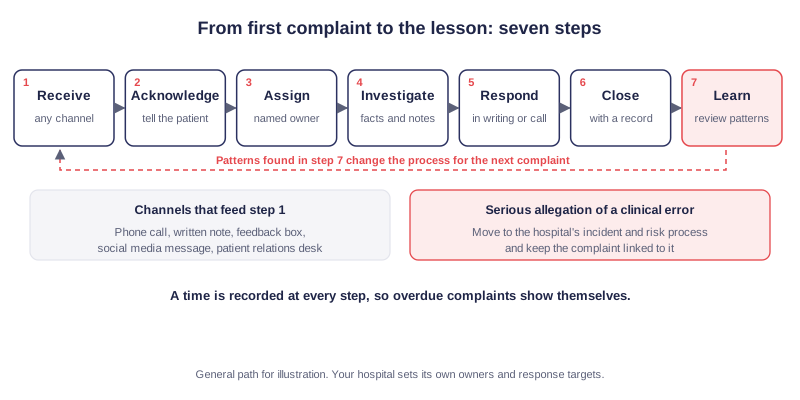
A good complaint record has a small number of parts. It identifies the patient or states that the complainant is anonymous. It records the channel, such as a phone call, a written note, a feedback box, a social media message or a visit to the patient relations desk. It records the department and the category, such as billing, waiting time, staff behaviour, cleanliness, food or clinical care. It names an owner and sets a target time for each step, which the hospital defines. It holds the investigation notes and the response sent to the patient, and it records the patient's acceptance or the reason the matter remains open.
Two points deserve special care. The first is severity. A complaint about a cold meal and a complaint alleging a clinical error need different handling, different owners and different confidentiality, and a serious allegation should move to the hospital's incident and risk process. The Compliance & Quality group of the ERP has incident reporting, described on our Compliance & Quality module page, and a good setup links a complaint to an incident when it needs one. The second is privacy. A complaint file holds personal and sometimes clinical information, so access should be limited to those who need it.
When a patient is not satisfied with the hospital's answer, the patient can take the matter further, for example to a consumer commission or a medical council. A hospital with a clean complaint record, a timely response and an honest investigation is in a far better position than a hospital with a pile of unlogged phone calls. Ask the vendor to show the oldest open complaint, the average time to close by category and the complaints that missed the hospital's own targets.
Surveys & NPS: asking in a way that you can use
A feedback form in a box near the reception desk gives a hospital a few letters a month, mostly from the delighted and the furious. A structured survey sent to every discharged patient gives a hospital numbers it can compare across wards and months. The Surveys & NPS entry is for that second approach.
How the Net Promoter Score works
The Net Promoter Score, or NPS, comes from one question: how likely are you to recommend us to a friend or colleague, on a scale from 0 to 10. Fred Reichheld of Bain & Company introduced it in a Harvard Business Review article, The One Number You Need to Grow, published in December 2003. Respondents who answer 9 or 10 are called promoters, those who answer 7 or 8 are passives, and those who answer 0 to 6 are detractors. The score is the percentage of promoters minus the percentage of detractors, and it is a whole number between minus 100 and plus 100.
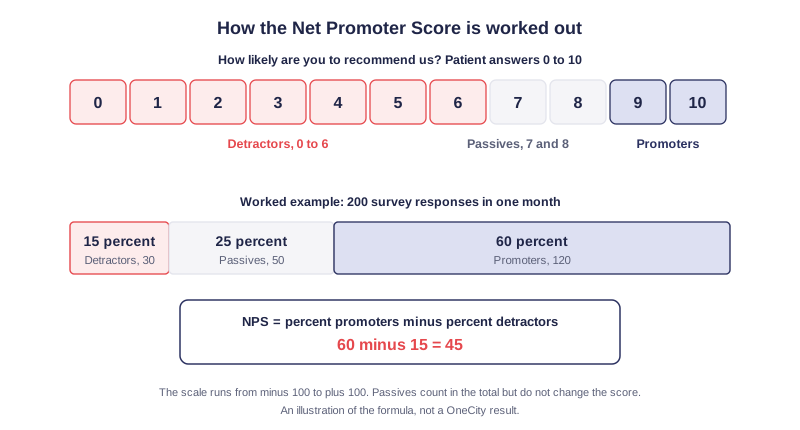
Take a hospital with 200 survey responses in a month. Of these, 120 gave a 9 or 10, which is 60 percent promoters. Fifty gave a 7 or 8, which is 25 percent passives. Thirty gave a score of 0 to 6, which is 15 percent detractors. The NPS is 60 minus 15, which is 45. Passives count in the total but do not change the score.
Use NPS with care
NPS is popular and also criticised. Researchers have questioned how well it predicts growth compared with other loyalty measures, and the single number gives no detail about what went right or wrong. Hospitals have a further caution. Willingness to recommend is a measure of experience, not of clinical quality, and a patient can be delighted by a kind nurse and still have received poor care, or the other way round. Treat NPS as one signal beside clinical outcomes and infection data, never as a replacement.
The strength of a survey tool is in the follow up questions. A score of 4 with no comment is a number. A score of 4 with a comment that says the discharge took six hours is a task. Ask the vendor to show how comments attach to scores, how scores split by department, doctor and ward, and how a detractor response creates a call back to the patient. Keep surveys short, because a long form reduces response and adds fatigue. Ask about the language of the survey as well, since patients answer more readily in the language they speak at home.
Use a survey for improvement and not for punishment. If ward staff think the score will be used to blame them, scores drift upward as the staff coach the patients. A hospital that treats feedback as a learning tool collects more honest answers and improves faster.
How the three entries should work together
Consider a patient who was discharged on Friday. On Saturday the survey goes out, and the patient gives a 3 and writes that the final bill had an item that was never explained. The detractor response creates a task. The patient relations officer calls on Monday, finds the billing error and corrects it, and logs the call as a complaint with a resolution. The patient is removed from promotional campaigns for 30 days, a rule that the hospital sets. A month later, the patient gets a follow up reminder, which is a service message and not a promotion. When the quality team reviews the month, it sees billing explanations as the top complaint theme and fixes the discharge counselling script.
That loop is simple, and a connected ERP is the natural place to run it, because the survey, the complaint, the campaign list and the bill all sit in one database. We cannot promise that every link in the loop is live in every deployment, so ask for it to be shown on screen. If a vendor can run this story from end to end, the product is working as a patient relationship tool. If it can only send messages, it is a messaging tool with a CRM label.
Questions to ask any vendor before you buy
These questions work for OneCity and for every competitor. The right test is a live screen, not a slide.
- Show me how consent is recorded for a patient, and how a campaign uses it to select recipients.
- Show me an opt out and how it is respected across every campaign.
- Show me how a message template is stored with its approval details and category.
- Show me how a complaint is logged from a phone call and from a written note, and how it is assigned.
- Show me what happens when a complaint is overdue, and who is told.
- Show me how a serious complaint is linked to an incident report.
- Show me a survey sent after discharge, the NPS by department and the comments behind a low score.
- Show me how a detractor creates a call back task.
- Show me who can see complaint files and patient lists, and the log of who looked.
- Show me how I can export every complaint and survey if we ever change systems.
A small hospital may begin with simple reminders and a complaint register, and that is a sound start. Choose a system that will still serve you when you add a second branch, a patient app and a quality team that wants monthly reports.
What this page does and does not claim
The three sidebar entries come from a screen capture of the OneCity ERP demo tenant taken on 30 September 2026. We did not describe fields we have not seen, and the NPS example above is an illustration of the formula, not a OneCity result. The description of data protection and telecom rules is general information drawn from public sources, and these rules are changing, so confirm the current position with qualified counsel. OneCity does not hold a NABH certificate for its software, and nothing on this page says that using the module makes a hospital compliant with NABH, the DPDP Act or TRAI rules.
If you want to see the module with your own patient communication plan, book a demo and bring your last month of complaints with you. The pricing page shows the plans, and we suggest confirming module inclusion for your plan in writing.
Frequently asked questions
What does the CRM & Feedback module include in OneCity?
In the OneCity ERP sidebar, the group has three entries: CRM Campaigns, Complaints, and Surveys & NPS. Ask for a live walkthrough of each, because the depth of each screen changes as the product grows.
How is NPS calculated?
Patients rate from 0 to 10 how likely they are to recommend the hospital. Scores of 9 and 10 are promoters, 7 and 8 are passives, and 0 to 6 are detractors. NPS is the percentage of promoters minus the percentage of detractors. With 60 percent promoters and 15 percent detractors, the score is 45.
Do I need patient consent to send follow up messages?
The DPDP Act, 2023 requires consent for processing personal data in most cases, and the rules are being phased in from November 2025. Record what each patient agreed to, through which channel, and honour withdrawal. Confirm the current position with qualified counsel.
What is DLT registration for hospital text messages?
Under TRAI rules, a business registers on the operators' DLT platform, registers its sender name and gets each message template approved before sending commercial texts. Your messaging provider will tell you the categories and current time restrictions for promotional messages.
Does NABH require a complaint system?
NABH standards cover patient rights, including how patients can raise concerns, and an assessor expects to see how complaints are received and resolved. A complete paper register meets the evidence need. Software makes complaint records easier to keep, search and review.
Is NPS a good measure of hospital quality?
It is a measure of patient experience and loyalty, not of clinical quality, and researchers question how well it predicts growth. Use it beside clinical outcomes and infection data, and read the comments behind each score.
Is the CRM & Feedback module included in the free or Starter plan?
We do not state plan inclusion for this module on this page. Check the pricing page and ask for written confirmation of which modules your plan includes before you sign.
Sources
NABH Hospital Accreditation Standards, 6th edition, January 2025 (portal.nabh.co). JSA Prism, Infotech, November 2025, summary of the Digital Personal Data Protection Rules, 2025 (jsalaw.com). Frederick F. Reichheld, The One Number You Need to Grow, Harvard Business Review, December 2003 (hbr.org). The TRAI description is general and based on public guides to the TCCCPR 2018 and DLT system. The ERP sidebar names come from a screen capture of the OneCity demo tenant dated 30 September 2026. The NPS example is our own illustration. This page is general information. It is not legal advice, and rules change, so confirm every point with qualified counsel and the relevant authority.
Related reading
Bring your last month of complaints to a live demo and see them as records.
Book a demo