General information for hospital buyers. It is not legal, tax or medical advice. Verify regulatory points with the relevant authority or a qualified professional.
Where the two names come from
HIS is the term used in health informatics and in reference works, where a hospital information system is the software that handles the administrative and operational needs of a hospital, often with clinical departments connected to it. HMS is a term Indian vendors and buyers use often, and hospital management software is a phrase many owners search for. A widely used encyclopedia entry on hospital information systems says in plain words that a HIS is also referred to as hospital management software or a hospital management system.
So the two names describe one product family. If you keep only one point from this page, keep that one. The rest of the guide is about what to look at instead, because the label on a quote tells you little about what the quote contains.
Where the definitions disagree
Sources do not agree on where a HIS ends and the clinical systems begin. One common definition describes a HIS as the system that manages patient demographics, insurance and billing information and integrates other clinical information systems. That makes it an administrative and financial core with clinical systems attached. Another describes a HIS as covering the administrative and operational needs of a hospital, with laboratory, radiology and pharmacy systems as sub systems that can connect to it.
Both readings fit the everyday use of HMS, but they draw the edge of the clinical part in different places. That disagreement is the reason a buyer cannot rely on the word. Two vendors can use the same acronym and mean two different amounts of software.
Three differences you will hear, and how they hold up
You may hear three ways of separating the two names. Here is a plain verdict on each.
Claim 1: HIS is for big hospitals and HMS is for small ones
This is sometimes said, and it is not a rule. Nothing stops a 30 bed hospital from buying something called a HIS, and nothing stops a 500 bed hospital from running something called an HMS. Size decides which modules, how many users and what level of support you need. The acronym does not decide any of those.
Claim 2: HIS is clinical and HMS is administrative
You will also hear the reverse, and the two definitions above show why. One treats a HIS as the administrative and financial core. Another treats it as the wider system with the clinical parts inside it. When a claim can be reversed and still be supported by a source, it is not a safe basis for a purchase.
Claim 3: HIS connects many separate systems and HMS is a single system
This one hides a real question, but it belongs to the product and not to the name. The real question is whether registration, lab, pharmacy, billing and stores share one database, or are separate products joined by interfaces. Interfaces are common in large hospitals that already own a lab or imaging system. Each interface is one more thing to test, pay for and keep working after every update. Ask the vendor which model they sell, and ask to see it working on your kind of case.
The terms that really do differ
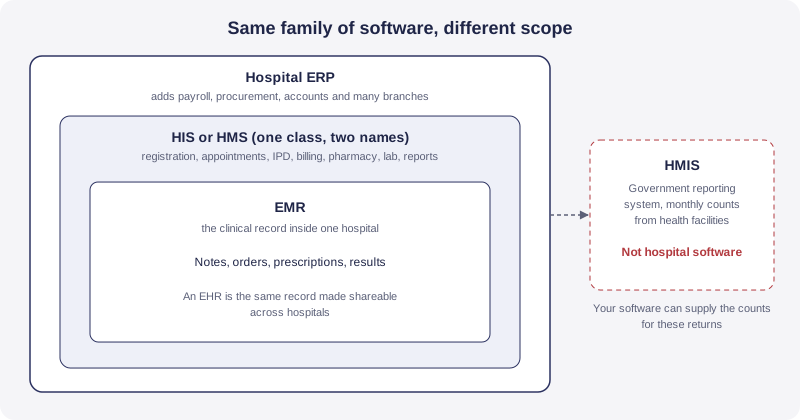
The confusion has a useful side. Because HIS and HMS blur together, buyers often miss the terms that are genuinely different. This table sets them out. For a fuller treatment of the clinical terms, see our guide to EMR and EHR software in India.
| Term | What it means | What it usually covers | What it usually leaves out |
|---|---|---|---|
| HIS or HMS | The core hospital system | Registration, appointments, OPD, IPD, billing, pharmacy, lab, reports | Payroll, procurement and multi branch control, unless the vendor adds them |
| EMR | The digital patient chart inside one hospital | Notes, orders, prescriptions, results | Billing, stores and scheduling, unless bundled |
| EHR | A record built to be shared across providers | The same clinical content, in a shareable form | Hospital operations |
| Hospital ERP | The core hospital system plus the back office | Everything above, plus payroll, procurement, accounts, several branches | Nothing by design, but depth varies by vendor |
| HMIS | The government health management information system | Monthly counts reported by health facilities | Patient care and hospital operations |
| LIS, RIS, PACS | Departmental systems for lab, radiology reports and images | One department each | The rest of the hospital |
| Hospital CRM | Patient relationship tools | Recall, follow up, referrals, feedback | Clinical records and billing |
Our explainer on the hospital management system covers the HMS versus ERP distinction in more depth, so we will not repeat it here. The short version is that an ERP is an HMS with the back office added, and the boundary is a matter of degree.
HMIS is the term that trips people up
HMIS looks like an abbreviation for the same thing, and it is not. In India, the Health Management Information System is a government reporting system under the National Health Mission. Facility staff enter data in monthly formats, and the data is then consolidated at block, district and state levels. The Ministry of Health and Family Welfare is the authority to check for current reporting formats and portals.
The trap is a simple one. A hospital manager may hear that a vendor supports HMIS and assume the vendor sells hospital software. Or an official may ask whether your software is HMIS compliant, and the vendor may answer a different question from the one asked. Clarify which meaning is in play: whether your software can produce the counts that go into government returns, or whether you must file through the government portal. Good hospital software helps with the counts, because counts drawn from real records are more reliable than counts tallied by hand at month end. It does not replace the filing.
What the National Informatics Centre's own wording shows
The National Informatics Centre (NIC) builds NextGen eHospital. On its project page, NIC describes NextGen eHospital as a comprehensive healthcare management system. It lists twelve modules: patient registration for OPD and casualty, appointment, IPD admission, discharge and transfer, electronic health records, billing, a lab information system, a radiology information system, clinics, dietary, laundry, store and pharmacy, and OT management. At the time of writing, the same page says it is deployed live in 68 health facilities across the country.
Notice how NIC words it. In the description we read, it does not stop to say whether the product is a HIS or an HMS. It describes the product by its modules. That is the habit we recommend to buyers. Our page comparing OneCity and eHospital by NIC sets the two side by side.
What to write in your requirement instead of a label
A requirement that says we need a HIS invites every vendor to answer yes. A requirement that lists workflows forces a specific answer for each one. Write your needs as short workflow lines, and ask each vendor to point to the module that covers each line.
- Patient identity. One UHID per patient, a duplicate check at registration, and ABHA linkage where the patient has one.
- OPD. Appointment, token or queue, consultation notes and a prescription printed or sent to the patient.
- IPD. Admission, bed allotment, transfer between wards and a discharge summary.
- Lab and radiology. Orders, results filed in the patient record, and printed reports. Add image storage only if you need it.
- Pharmacy and stores. Batch and expiry, dispensing against a prescription, reorder levels and issue to wards.
- Billing. OPD and IPD bills, package rates, TPA and PMJAY claims, and correct GST treatment.
- Management reports. Occupancy, revenue and collections for the owner, without a spreadsheet in between.
- Access and audit. Roles for each type of staff, and a trail of who changed what.
- Data. Export in open formats, hosting location and backup arrangements, in writing.
- Compliance. ABDM readiness, DPDP duties and the licences your services need.
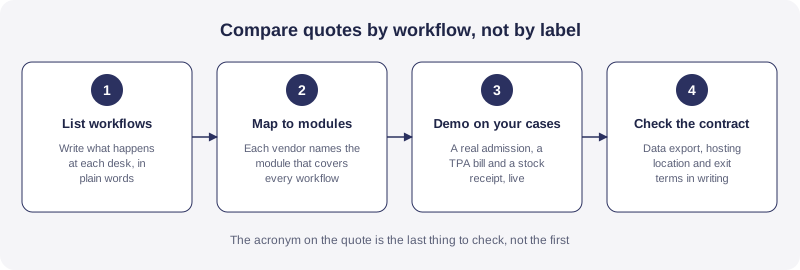
Then ask for a demo on your own cases: a real admission, a TPA bill and a stock receipt, entered live. A scripted demo with clean sample data proves little. Our guide on how to choose hospital management software in India goes deeper on the demo and the shortlist, and our comparison of hospital software in India is a fair starting list.
ABDM does not care about the acronym
Buyers sometimes ask whether a HIS or an HMS fits the Ayushman Bharat Digital Mission better. The answer is neither. What matters to ABDM is what your software can do. It should create or link ABHA numbers at registration. It should act as a Health Information Provider when you share records with patient consent, and as a Health Information User when you request them. And your facility should be listed in the Health Facility Registry, which ABDM describes as a repository of the health facilities of the country across different systems of medicine.
The ABDM website says vendors can register their software as a HIP or HIU in its sandbox and test linking records and processing consent requests. Ask any vendor exactly what they have tested and what has been certified, and get it in writing. Our guides to ABDM and ABHA integration and to Health Facility Registry registration explain what to implement first. For the record, OneCity is ABDM ready, not ABDM certified.
How to read a vendor's pitch
Once you know that the label carries little information, a few phrases in a pitch become warning signs.
- HIS used as proof of quality. If the pitch leans on the word and never shows a module list, ask for the list.
- Cloud HIS with no hosting details. Ask who hosts it, where, and what happens when the line drops. Our guide to cloud based hospital management software lists the questions to ask.
- Fully integrated with no explanation. Ask whether that means one database or several products with interfaces.
- ABDM compliant with no detail. Ask what was tested, in which environment and when.
- Low headline price and many add ons. Lab, pharmacy stock and payroll are often extra. Ask for the full module price list.
- No data export clause. Our guide to vendor lock in and data ownership explains what the contract should say about export and exit.
Common mistakes when the label drives the decision
Poor purchases often come from a mismatch, not from a bad product. The mismatch is between what the buyer thought the label promised and what the quote contained. Four mistakes are common.
- Assuming the label means clinical depth. A product called a HIS may have a thin OPD screen and no templates for your specialties. Ask to see a consultation for your own specialty, entered live, not a general demo.
- Buying the front half and forgetting the back half. Registration, OPD and billing are easy to price. Stores, purchase, payroll and accounts are usually quoted separately or left out. If your hospital runs stores on registers today, count that work as part of the scope, or the same problem will simply move into the new system.
- Comparing prices across different scopes. A quote for four modules and a quote for eleven cannot be compared by total price. Line them up by workflow first, then compare what each workflow costs. Our hospital software pricing guide explains the common models.
- Skipping the reference call. Ask each shortlisted vendor for a hospital of your size and type that has used the same modules for at least a year, and ask that hospital what went wrong in the first three months. The answer is worth more than any brochure.
None of these mistakes needs technical knowledge to avoid. They need a written list of workflows, a few pointed questions, and the patience to compare the answers side by side before anyone signs.
A worked example: three quotes for a 40 bed hospital (hypothetical)
Take a hypothetical hospital with 40 beds. It has OPD, IPD, a small lab, a pharmacy and a TPA desk. The owner asks three vendors for quotes and receives three documents with three different labels.
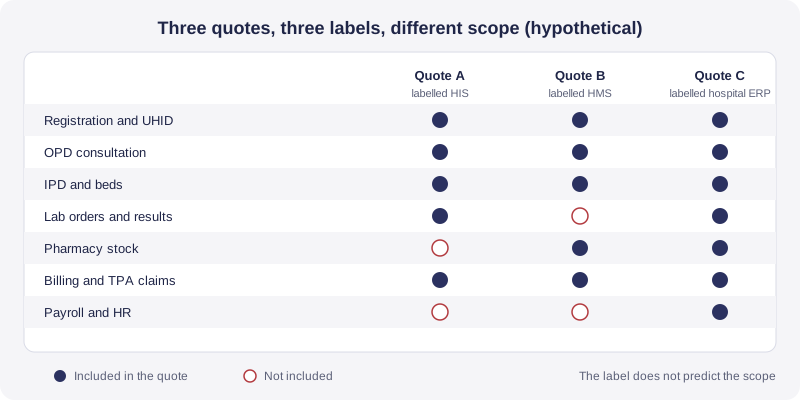
Quote A is labelled HIS and is the cheapest. It has no pharmacy stock and no payroll, so the pharmacy would keep running on registers. Quote B is labelled HMS and includes pharmacy stock, but it has no lab module, so lab orders stay on paper. Quote C is labelled hospital ERP and includes all seven modules, at the highest price.
An owner who compared labels would learn nothing from this. An owner who compared modules would see at once that the cheapest quote leaves two departments outside the system, and that the difference in price is largely explained by the modules that are missing. The right question is not which is a HIS. It is which quote covers the workflows in the requirement, and what the missing ones would cost to add later. The example is hypothetical, and real quotes will vary.
Which scope do you need, by type of hospital
The useful decision is about scope, and it depends on the kind of hospital you run.
- Single doctor clinic. An EMR with billing and appointments is usually enough. See our page on clinic management software.
- Nursing home or a hospital of 20 to 50 beds. Full HMS scope: OPD, IPD, billing, pharmacy and lab. The back office can be light at first.
- Multi specialty hospital. HMS scope with lab, radiology, pharmacy stock, TPA claims and a proper back office, because stores, HR and accounts start to matter.
- Hospital group. Hospital ERP with one shared record across branches, since many sites make separate systems expensive to reconcile.
At each step up, the extra scope has a cost, and you should pay for it only when the hospital needs it. It is better to start with the workflows that hurt most and add modules as the team gets comfortable than to buy everything on day one and use a third of it.
How OneCity uses these words
We call OneCity a hospital ERP and CRM. It covers the scope of an HMS across 34 module groups, from registration and OPD to IPD, lab, radiology, pharmacy, billing and TPA claims, and it adds the back office and patient recall on top. Whether you write that down as a HIS, an HMS or a hospital ERP is your choice, and it will not change what the software does. The hospital management software page describes the whole product.
A few limits, stated up front. OneCity is cloud hosted and has no offline mode. It is ABDM ready, not ABDM certified. Its PACS bridge is PACS ready and has not been tested against a live modality. If a government tender or an institution requires a particular term, follow the term they use, and attach a module by module list so nothing depends on the word. You can try the product free for up to 5 doctors, or book a demo and bring your workflow list with you.
Frequently asked questions
What is the difference between HIS and HMS?
In everyday Indian use there is no reliable difference. HIS (hospital information system) and HMS (hospital management system) name the same class of software that runs registration, appointments, OPD, IPD, billing, pharmacy and lab from one system. Some people draw a line by hospital size or by clinical versus administrative scope, but those lines contradict each other.
Is a HIS better than an HMS?
No. The label does not measure quality. A product called HIS can lack modules that a product called HMS includes, and the reverse. Compare the module list, the demo on your own workflows and the export and exit terms.
Is HMIS the same as HIS?
No. HMIS in India usually means the government Health Management Information System under the National Health Mission, where health facilities report monthly data. It is a reporting system, not hospital software. Your hospital software can supply the counts, but it does not replace the reporting.
Are EMR and HIS the same thing?
No. An EMR is the digital patient chart inside one hospital. A HIS or HMS is wider, adding registration, appointments, billing, pharmacy and lab. Many HMS products include an EMR as one of their modules.
Which term should I use in a purchase document?
Use workflow lines instead of a label, and ask each vendor to name the module that covers each one. If an institution or tender template requires a specific term, use it, and attach a module by module list so the meaning is clear.
Does the label affect ABDM or NABH compliance?
No. ABDM depends on what the software can do, such as ABHA linkage and sharing records with consent as a Health Information Provider. NABH depends on the records and processes the hospital keeps. Neither is decided by whether the vendor says HIS or HMS.
Sources
NextGen eHospital project description, National Informatics Centre (nic.gov.in). Ministry of Health and Family Welfare, for the Health Management Information System under the National Health Mission (mohfw.gov.in). Ayushman Bharat Digital Mission, Health Facility Registry and sandbox (abdm.gov.in). Definitions of a hospital information system were read from the Wikipedia entry on hospital information systems and the ScienceDirect topic overview. Module names for OneCity come from the OneCity module pages. This guide is for general buying information only. It does not give legal, tax or medical advice, and it is not a compliance opinion. Rules and portals change, so check the relevant authority's website and speak to a qualified professional before you act on any of it.
Related reading
Bring your workflow list to a live demo and see each line in the software.
Book a demo