
Compliance · Blood Bank · 13 min read
e-RaktKosh Registration Is Now Compulsory for Every Blood Bank
The Drugs Controller General of India has issued a circular making registration on the e-RaktKosh portal compulsory for every licensed blood centre in the country, government and private alike. This is a genuine regulatory shift, not a renewed request for voluntary participation — a blood bank's e-RaktKosh status is now tied to its underlying licence standing, and daily stock and donor data updates are the expectation, not a one-time registration exercise. What follows covers what actually changed, what ongoing compliance requires day to day, and what a hospital's blood bank software needs to handle so this doesn't become one more manual reporting task competing for a small team's attention.
What actually changed
e-RaktKosh has existed since 2016 as the government's centralised blood bank management platform, but participation had effectively been a mix of encouragement and state-level advisories rather than a single, unambiguous national mandate. That changed with a DCGI circular strengthening regulatory oversight specifically to ensure real-time national monitoring of blood availability — registration on the e-RaktKosh portal is now compulsory for every licensed blood centre, not a best-practice recommendation some hospitals had already adopted and others hadn't gotten around to.
What e-RaktKosh actually is
e-RaktKosh is a web-based platform initiated by the Ministry of Health and Family Welfare, built as a Centralized Blood Bank Management System with a citizen-facing portal layered on top. The citizen side lets the public search for nearby blood banks, check blood group and component availability, and find donation camps. The underlying management system is what blood banks themselves use — stock entry, donor records, and compliance reporting — built with a modular, rule-based architecture specifically so it could incorporate different state and stakeholder requirements without a separate system for each. It integrates with UMANG, e-Hospital, the National Health Portal, and other flagship government digital health products.
What compliance actually requires day to day
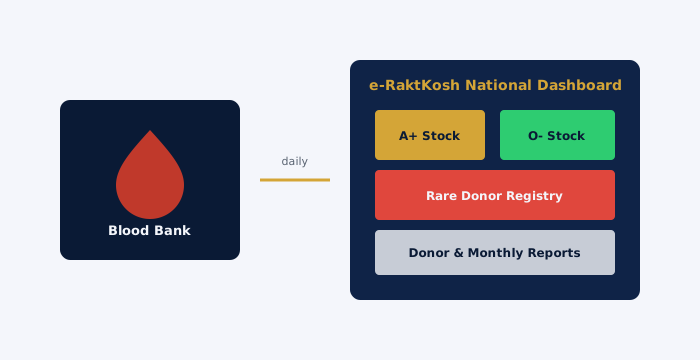
Registration itself is only the starting point. Blood centres are expected to enter and update blood stock availability by group and component, alongside donor data and monthly reports, on an ongoing basis — daily updates, not a static registration record left untouched after initial signup. This is the detail that trips up hospitals that treat e-RaktKosh as a one-time compliance box: a blood bank registered on the platform but not maintaining live stock data isn't meaningfully compliant with what the mandate is actually for, which is real-time national visibility into blood availability.
| Requirement | Frequency |
|---|---|
| Blood stock availability by group/component | Daily |
| Donor data | Ongoing, as donations occur |
| Compliance and monthly reports | Monthly |
| Licence renewal (dual, federal + state) | Every 5 years |
How this connects to blood bank licensing
Blood bank operations in India are regulated under the Drugs & Cosmetics Act, requiring licences from the Drug Controller General for operation, with dual licensing by both federal and state regulatory bodies made mandatory since 1993, renewed every five years. e-RaktKosh enforces the Drug & Cosmetics Act and National Blood Policy standards directly, which is exactly why the DCGI's compulsory-registration circular carries real regulatory weight rather than functioning as a parallel, optional system sitting alongside licensing — it's positioned as part of the same oversight framework, not a separate initiative a blood bank could reasonably deprioritise.
The Rare Donor Registry integration
Beyond routine stock monitoring, the government has moved to integrate the Rare Donor Registry of India, developed by ICMR-NIIH, directly with e-RaktKosh — creating a single-window interface connecting rare blood group donors with hospitals and blood banks nationally. This specifically helps patients with conditions like thalassemia and sickle cell anaemia, and those needing ultra-rare types such as Bombay blood group or Rh-null, find matches faster than a hospital's own local network could manage alone. For a hospital treating patients with rare transfusion needs, this integration is a direct clinical capability, not just a regulatory formality — it only works, though, if the local blood bank's own e-RaktKosh data is genuinely current.
What hospital software needs to handle
Given the daily-update expectation, manually re-entering blood stock data into a separate e-RaktKosh login, on top of whatever internal blood bank system a hospital already runs, is exactly the kind of duplicate-entry burden that causes compliance to quietly lapse over time. Software should push stock updates to e-RaktKosh directly from the same system staff already use to log blood bank activity, not require a second manual entry step every single day. It should track donor records in a format that maps cleanly to what e-RaktKosh expects, and flag when required updates haven't been pushed within the expected window, rather than assuming compliance continues indefinitely after initial registration.
What tends to go wrong in practice
The most common gap isn't refusing to register — it's registering once and then letting daily updates slip as staff attention moves to other priorities, especially in a hospital where the blood bank sits under a small team already stretched across multiple responsibilities. A second gap is treating e-RaktKosh as a separate system entirely disconnected from the hospital's own blood bank records, creating two versions of the same data that inevitably drift out of sync. A third, specific to smaller hospitals, is assuming a small blood storage unit rather than a full blood bank is exempt — the mandate applies to licensed blood centres broadly, and a facility uncertain about its own classification should confirm directly with its licensing authority rather than assume exemption.
What a first-time registration actually requires
A blood bank registering fresh needs to provide its valid licence copy as part of the registration process, since e-RaktKosh's own compliance framework is explicitly tied to licensing status rather than treating registration as a separate, independent formality. The portal issues a user ID and password after registration, and blood centres are expected to begin entering stock and donor data promptly rather than treating the credential itself as the finish line. For a hospital with an existing blood bank that predates this compulsory mandate, confirming whether a prior registration already exists — rather than assuming a fresh signup is needed — avoids creating duplicate records for the same facility.
Real-world adoption before the mandate
Even before registration became compulsory, e-RaktKosh had meaningful reach: the platform is available via web and mobile apps on both Android and iOS, and is integrated with UMANG alongside CDAC's own flagship products e-Sushrut and e-Upkaran. During the COVID-19 outbreak specifically, the Ministry worked with the Blood Cell under the National Health Mission to extend the platform's donor-facing features — allowing donors to request lockdown passes or arrange mobile collection vans — precisely because blood banks were struggling with patients unable to physically reach them for arrangement. That pandemic-era expansion is part of why the platform's technical foundation was already broad enough to support a genuine compulsory nationwide mandate once the DCGI circular made participation mandatory rather than optional.
Why real-time data matters beyond compliance optics
The stated purpose behind the compulsory mandate is national monitoring of blood availability — meaning the value of e-RaktKosh compliance isn't primarily about satisfying an inspector, it's about a patient in one city being able to find blood at a specific hospital in another city during a genuine emergency. A blood bank with stale e-RaktKosh data doesn't just risk a compliance flag; it risks being functionally invisible to a patient or referring hospital that's relying on the platform's real-time picture to make an urgent decision about where to send someone. That's the practical stake behind what might otherwise look like routine government reporting.
What multi-facility hospital groups should plan for
A hospital chain running blood storage or blood bank facilities at multiple sites faces the same per-facility compliance reality seen across other ABDM-adjacent mandates: each location's blood bank needs its own e-RaktKosh registration and its own daily update discipline, since the platform tracks stock at the facility level, not at a group or corporate level. A group with strong compliance at its flagship hospital but inconsistent updates at smaller satellite locations doesn't present a genuinely compliant picture nationally — it presents a patchwork that undermines the entire point of a national real-time monitoring system. Centralising oversight of e-RaktKosh compliance across every site, rather than trusting each location to self-manage independently, is the only way a multi-site group avoids exactly this patchwork outcome.
The broader pattern: government mandates moving from voluntary to compulsory
e-RaktKosh's shift from encouraged participation to a compulsory DCGI directive fits a pattern seen elsewhere in India's digital health infrastructure — HFR registration remains technically voluntary today but is increasingly a practical necessity for PMJAY claims, and AERB licensing has always been mandatory but enforcement has tightened over time. Hospitals that treat a currently-voluntary or newly-compulsory digital health requirement as low priority risk being caught flat-footed when the regulatory position hardens, as it just did here. The more defensible posture, across all of these requirements, is registering and maintaining compliance proactively rather than waiting until a mandate makes inaction untenable.
How the mandate ties into NABH and quality accreditation
Blood bank operations already sit under NABH's accreditation standards as one of the specific facility types NABH assesses, alongside general hospital, eye care, and diagnostic laboratory accreditation. A blood bank pursuing or maintaining NABH accreditation should treat e-RaktKosh compliance as part of the same quality-documentation picture an assessor reviews, not a separate government reporting obligation unrelated to accreditation status. Consistent, current e-RaktKosh data is, in practice, exactly the kind of operational discipline an NABH assessor looks for as evidence of genuine ongoing quality management, rather than documentation assembled specifically for the assessment visit itself.
What to check before assuming your blood bank is compliant
A short, practical checklist separates a genuinely compliant blood bank from one that registered once and stopped there. Confirm the facility actually holds current e-RaktKosh login credentials, not a registration attempt that was started but never completed. Check when stock data was last updated — if it's been more than a day or two, that's a live compliance gap, not a historical one. Confirm donor data entry is current, not weeks behind actual donation activity. And confirm whoever is responsible for daily updates has a clear, named ownership of the task, rather than it being everyone's job and therefore, in practice, nobody's.
Where blood bank compliance connects to other facility requirements
Blood bank compliance sits alongside several other facility-specific regulatory requirements hospitals track. NABH accreditation assesses blood bank operations as part of its standards, and AERB equipment licensing and Health Facility Registry registration follow similar per-location tracking logic. Hospitals also managing canteen operations should see our guide to FSSAI licensing, which follows the same daily-compliance pattern. For imaging-related diagnostic work that intersects with blood bank operations in some facilities, our guide to PCPNDT Act compliance covers a related but distinct set of requirements. And for hospitals weighing whether a unified platform is worth consolidating all of this tracking, why tier-2/3 hospitals need a unified ERP makes that case directly, with our implementation timeline guide covering how long that transition realistically takes, and our full module list showing exactly what's included.
How OneCity's blood bank module handles this
OneCity's blood bank module tracks stock by group and component, donor records, and compliance reporting in the same system used for daily blood bank operations, structured to map directly onto what e-RaktKosh expects rather than requiring a second manual entry process. This ties into the same quality and compliance tracking used across other regulatory requirements, so blood bank compliance status sits alongside the rest of a hospital's regulatory picture rather than in a separate, easily-forgotten silo.
Frequently asked questions
Is e-RaktKosh registration mandatory for private blood banks?
Yes. The Drugs Controller General of India has issued a circular making e-RaktKosh registration compulsory for every licensed blood centre in India, government and private alike, as part of nationwide real-time monitoring of blood availability.
What data does a blood bank need to update on e-RaktKosh?
Blood stock availability by group and component needs updating daily, alongside donor data and monthly reports. Ongoing stock entry is expected, not a one-time registration exercise.
What happens if a blood bank doesn't register on e-RaktKosh?
Since registration is compulsory under a DCGI directive tied to blood bank licensing, non-compliance risks action from the licensing authority, since e-RaktKosh compliance is now treated as part of a blood centre's regulatory standing, not an optional convenience.
Is e-RaktKosh only for finding blood, or does it manage blood bank operations too?
Both. The citizen-facing side helps the public find blood banks, availability, and donation camps. The underlying Centralized Blood Bank Management System component is what blood banks themselves use to manage stock, donors, and compliance reporting.
Sources and further reading
The compulsory registration circular is reported by DrugsControl Media Services, and platform detail is drawn from the official e-RaktKosh portal published by the Ministry of Health and Family Welfare. Confirm current registration requirements directly with your state drug control authority or on the e-RaktKosh portal itself.
Push blood stock updates to e-RaktKosh without duplicate data entry
Free up to 5 doctors. No card, no setup fee.
Book a demo See pricing