
Compliance · Radiology · 14 min read
AERB License for Hospital X-Ray and CT: What It Actually Takes
No hospital in India can legally operate an X-ray machine, CT scanner, mammography unit, or C-arm for patient diagnosis without a licence or registration from the Atomic Energy Regulatory Board, obtained through its eLORA portal. This isn't a formality — AERB directly regulates equipment type-approval, room shielding, staff qualifications, and ongoing quality testing, and a facility operating without a valid licence is doing so illegally regardless of how good its clinical care is. Here's what the process actually involves, what commonly delays or rejects an application, and what a hospital's records need to track once the licence is granted — covering the specific procedural detail, drawn from AERB's own published guidelines, that most vendor and consultancy content summarises too loosely to actually act on.
What AERB actually regulates
The Atomic Energy Regulatory Board licenses and monitors any facility using ionising radiation equipment for medical diagnosis: general radiography, dental X-ray (both intra-oral and hand-held), mammography, bone mineral densitometry, mobile X-ray machines, C-arms, CT scanners, and interventional radiology and cath lab equipment. Licensing operates under the Atomic Energy (Radiation Protection) Rules, 2004, with all applications submitted and tracked through the eLORA portal rather than any offline process. The core requirement is simple to state and genuinely strict in practice: no diagnostic X-ray equipment can be operated for patient diagnosis without a valid Licence or Registration issued by AERB as the competent authority.
The eLORA licensing process, step by step
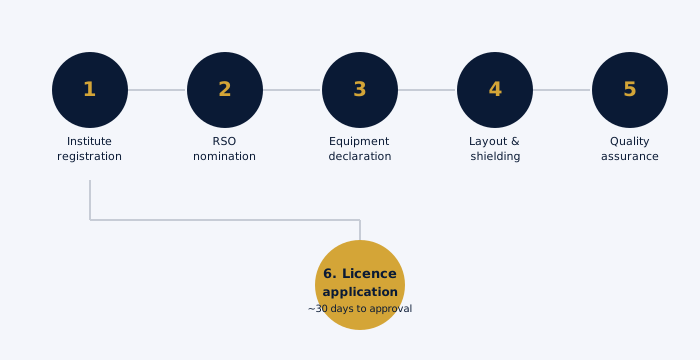
Registration begins with the institute itself registering on eLORA, followed by registering radiation professionals and formally nominating a Radiological Safety Officer. Equipment gets declared and verified next — every existing or new X-ray machine, CT scanner, or related device needs to be individually declared on the platform. Layout approval and shielding compliance follow, requiring a scaled room layout (typically 1:50) for most equipment types, though mobile radiography, C-arm, O-arm, and hand-held dental units are generally exempt from the layout-drawing requirement. Quality assurance and safety tooling come next, followed by the final licence or registration application itself, submitted once installation and QA reports are uploaded. Approval for a Licence for Operation typically takes around 30 days from that final submission, assuming the preceding steps were completed correctly.
| Step | What it involves |
|---|---|
| 1. Institute registration | Register the facility itself on eLORA |
| 2. RSO nomination | Register radiation professionals, nominate RSO |
| 3. Equipment declaration | Declare each X-ray/CT/C-arm unit individually |
| 4. Layout approval | Scaled room layout, shielding verification |
| 5. Quality assurance | Authorised third-party QA testing |
| 6. Licence application | Submit installation + QA reports, ~30 days to approval |
Who can actually be a Radiological Safety Officer
The RSO isn't a paperwork title — AERB sets real qualification requirements, and the level required scales with equipment risk. For general radiography and lower-risk equipment, a radiologist, related medical practitioner, or a technologist who has passed from a recognised institution can serve as RSO. For high-risk facilities specifically — CT and interventional radiology — the RSO must be a radiologist or technologist with at least three years of working experience in the field, not simply a qualified technologist meeting the general minimum. The RSO can be the employer personally or a delegated employee, but either way carries direct responsibility for ensuring the facility's ongoing compliance with radiation safety requirements, not just the initial application.
Layout and shielding requirements that actually get inspected
AERB's requirements go well beyond "install some lead shielding" — the specifics are detailed enough that missing one is a common reason applications stall. X-ray installations should be positioned away from high-occupancy areas like maternity, paediatric, and sonography departments. For CT and interventional radiology facilities specifically, the control console must sit in an adjoining room with a lead glass viewing window and working oral communication between the console and the procedure room — a control console positioned in the same room as the equipment, without this separation, does not meet the requirement. A permanent radiation warning symbol and instructions for pregnant women are mandatory at the entrance door of every installation. Radiation protection devices — barriers, aprons, goggles, thyroid shields — must be provided and periodically verified for shielding adequacy, not just supplied once at installation.
Quality assurance: not a one-time check
QA is a systematic requirement, not a single pre-licensing formality. An authorised third-party agency must conduct QA before the initial licence is granted, confirming the equipment performs to safety benchmarks. After that, testing recurs once every two years, or immediately after any major equipment repair — a hospital that treats QA as "done at installation" is not actually compliant once that two-year window passes, even if the original licence remains technically unexpired. Periodic safety status reports, in AERB's prescribed formats, must also be maintained by the registrant or licensee on an ongoing basis, not produced only when requested.
Why applications get delayed or rejected
Non-type-approved equipment is one of the most common rejection reasons — AERB only licenses equipment that itself carries AERB type-approval, so procuring equipment before confirming its approval status is a real risk, not a minor oversight. Missing or incomplete RSO qualifications, particularly for CT and IR facilities where the three-year experience threshold applies, is another frequent gap. Incomplete layout documentation — missing the scaled room drawing, or a control console that doesn't meet the lead-glass-window requirement for CT/IR — stalls applications at the layout approval stage specifically. And procurement without the required prior permission from the competent authority is a process-order mistake: equipment must be procured through AERB-validated suppliers with procurement permission obtained first, not purchased and only then declared.
Renewal timelines and what happens if you miss them
Licences, registrations, and RSO approvals all require renewal before expiry, and AERB is specific about the lead time: renewal applications must be submitted to the Head of the Radiological Safety Division at least three months prior to the validity date. A hospital tracking equipment licences manually, across a spreadsheet or a filing cabinet, risks missing this window simply because nobody flagged the countdown early enough — and operating equipment on an expired licence carries the same legal exposure as never having been licensed in the first place. Decommissioning a facility also requires formal consent from AERB, with authorised suppliers notified at least six months in advance of actual decommissioning.
What hospital software actually needs to track
Given how specific and date-driven these requirements are, treating AERB compliance as a filed-away paper certificate is a real operational risk. Software should track each piece of radiation equipment individually — not the facility as a whole — since licences, QA due dates, and RSO approvals attach to specific equipment and specific people, not a blanket hospital-wide status. It needs an alert well ahead of the three-month renewal deadline, not a reminder that fires the week licences expire. It should flag when QA is due at the two-year mark automatically, rather than relying on someone remembering the last test date. And it should tie RSO approval status to the specific equipment that RSO is qualified to oversee, since a general-radiography-qualified RSO isn't automatically qualified for a facility's CT unit.
Licence versus Registration — they're not the same thing
AERB's framework distinguishes between a Licence and a Registration, and which applies depends on the equipment's risk category. Higher-risk equipment — CT scanners, interventional radiology, cath labs — typically requires a full Licence for Operation, with the more detailed layout, shielding, and RSO-experience requirements described above. Lower-risk equipment, such as standard dental intra-oral units, mobile radiography, or hand-held dental X-ray devices, is often eligible for the lighter Registration category instead, which relaxes some requirements — the scaled room layout drawing, for instance, is explicitly not required for mobile radiography, C-arm, O-arm, or hand-held dental equipment. A hospital planning equipment procurement should check the correct category before assuming every unit needs the full licensing process, since applying the heavier process unnecessarily wastes time without any actual safety benefit.
Staff radiation dose monitoring
Beyond equipment and room compliance, AERB requires personnel monitoring services for all radiation workers — the staff operating or working near the equipment, not just the equipment itself. This typically takes the form of thermoluminescent dosimeter (TLD) badges worn by radiation workers and periodically analysed to track cumulative occupational radiation exposure over time. This isn't a one-time setup: it's an ongoing monitoring obligation for as long as radiation workers are employed at the facility, and it sits alongside — not instead of — the equipment shielding and warning-signage requirements. A facility's compliance picture is incomplete if it tracks equipment licensing carefully but has no functioning process for staff dose monitoring.
What non-compliance actually costs
Operating radiation equipment without a valid AERB licence isn't a minor regulatory gap — it's operating illegally, and the consequences extend beyond a hypothetical fine. A facility found non-compliant faces legal action, financial penalties, and potential closure of operations, which for a hospital means an entire imaging department going dark, not just a warning notice. Beyond the direct legal exposure, an unlicensed or under-compliant facility carries real liability risk if a radiation-related injury or overexposure incident occurs — a scenario where the absence of proper licensing, shielding verification, or RSO oversight becomes a central fact in any resulting legal or regulatory action, not a technicality.
Type-approval: why procurement order matters
One procedural detail causes more downstream problems than almost any other: AERB requires equipment to be NOC-validated or Type-Approved, procured from authorised suppliers, and procurement itself requires permission from the competent authority before the purchase — not after. A hospital that buys equipment first and attempts to sort out AERB compliance afterward risks discovering the specific model isn't type-approved at all, at which point the equipment cannot be licensed regardless of how well the room is shielded or how qualified the RSO is. Confirming type-approval status and securing procurement permission before signing a purchase order, not after equipment arrives, avoids this specific and entirely avoidable failure mode.
Decommissioning: an often-overlooked AERB obligation
Compliance obligations don't end when a hospital stops using a piece of equipment. Decommissioning a radiation facility requires the licensee to obtain formal consent from AERB before decommissioning proceeds, and authorised suppliers must be notified at least six months in advance of the actual decommissioning date. A hospital replacing an old CT scanner with a newer model needs to treat the outgoing equipment's decommissioning as its own compliance process, not an afterthought handled informally once the new machine is installed — skipping this step leaves a facility with an unresolved AERB obligation attached to equipment that's already been removed.
Where AERB compliance connects to the rest of your regulatory picture
AERB licensing is one piece of a hospital's broader facility-compliance picture. NABH accreditation covers institution-wide quality standards, while FSSAI canteen licensing and Health Facility Registry registration follow similar per-facility tracking logic. Hospitals planning a phased equipment rollout should also see our guide to realistic ERP implementation timelines. And where radiology findings intersect with medico-legal cases at your facility, our piece on MLC register software covers that connection directly, and our guide to unified ERP for tier-2/3 hospitals covers why tracking all of this on one platform beats juggling separate systems.
How OneCity's radiology module handles this
OneCity's radiology and RIS/PACS module tracks AERB licence status, QA due dates, and RSO approval per piece of equipment rather than as a single facility-wide compliance flag, with renewal alerts triggered well ahead of the three-month submission window rather than at the expiry date itself. This sits alongside the same quality and NABH audit module that tracks the broader accreditation documentation an AERB inspection or NABH assessment would both draw on, and connects to MLC-relevant patient flows where radiology findings intersect with medico-legal documentation.
For the compliance picture around imaging specifically, see our guide on PCPNDT Act compliance for ultrasound, which covers a distinct but related set of imaging-specific legal requirements.
Multi-site hospital groups and equipment scale
A hospital group operating imaging equipment across several locations faces a compliance scale problem that a single-facility clinic doesn't. Each piece of equipment at each location needs its own declaration, its own licence or registration, its own RSO oversight, and its own QA and renewal schedule — a group with equipment at five locations is effectively managing five to ten separate compliance timelines simultaneously, not one. Centralised tracking that shows every licence expiry, every QA due date, and every RSO approval status across the whole group in one view is the difference between catching a renewal deadline three months out with time to act, and discovering a lapsed licence during an unrelated equipment audit at one specific site.
How this connects to NABH accreditation
NABH assessors reviewing a hospital's quality standards expect to see radiation safety documentation as part of the broader accreditation picture, not as an isolated AERB-only concern. A hospital pursuing or maintaining NABH accreditation benefits from treating AERB licence records, RSO qualifications, and QA schedules as part of the same documentation trail an NABH assessment already requires for imaging services — duplicating this tracking separately for AERB and for NABH purposes, in two disconnected systems, creates exactly the kind of documentation gap an assessor is trained to notice. Software that maintains AERB compliance data as part of the same quality-and-audit trail used for NABH avoids that duplication entirely.
Common misconceptions about AERB compliance
A few misunderstandings show up repeatedly. Some facilities assume a valid business or hospital registration covers radiation equipment automatically — it doesn't; AERB licensing is entirely separate from general hospital licensing or Clinical Establishments Act registration, and one does not substitute for the other. Some assume the RSO role is a one-time appointment that doesn't need updating — but RSO approvals themselves have validity periods and require renewal, same as the equipment licence. And some treat AERB compliance as relevant only to radiology departments specifically, missing that dental clinics, orthopaedic departments using C-arms in theatre, and even standalone diagnostic centres operating a single mammography or BMD unit fall under the identical licensing requirement, scaled to that equipment's risk category rather than exempted because the department isn't formally "radiology."
What to check before signing an equipment purchase order
A short checklist, applied before rather than after procurement, prevents most of the delays covered above. Confirm the specific model carries current AERB type-approval, not just a general assurance from the supplier that "our equipment is compliant." Confirm the supplier is itself AERB-authorised to sell into the Indian market, since procuring from an unauthorised source complicates licensing regardless of the equipment's own approval status. Confirm procurement permission from the competent authority is actually in hand before the purchase order is signed, not treated as a formality to sort out afterward. And confirm the intended installation room's layout can realistically meet the shielding and control-console requirements for that equipment's risk category — discovering a room doesn't support the required lead-glass viewing window after equipment has already arrived is a expensive and avoidable planning failure.
Frequently asked questions
Is an AERB license mandatory for a hospital X-ray machine?
Yes. No diagnostic X-ray equipment can be operated for patient diagnosis in India without a Licence or Registration from AERB, obtained through the eLORA portal, under the Atomic Energy (Radiation Protection) Rules, 2004.
How long does it take to get an AERB license?
Approval typically takes around 30 days after the installation and QA reports are uploaded to eLORA, though this depends on completing equipment declaration, RSO approval, and layout verification first.
Who can be a Radiological Safety Officer?
A radiologist, related medical practitioner, or a qualified technologist, approved by the competent authority. For high-risk facilities like CT or interventional radiology, the RSO must be a radiologist or technologist with at least three years of relevant working experience.
How often does AERB-licensed equipment need Quality Assurance testing?
An initial QA is required before licensing, then testing every two years, or after any major repair. QA must be conducted by a third-party agency specifically authorised by AERB.
Sources and further reading
Regulatory requirements referenced here are drawn directly from the Atomic Energy Regulatory Board's own published guidelines for radiology facilities, and process detail from a compliance guide covering the eLORA licensing process. AERB requirements are updated periodically — confirm current rules directly on the eLORA portal or with AERB before relying on any secondary source, including this one.
Track AERB licences, QA dates, and RSO approvals per machine, automatically
Free up to 5 doctors. No card, no setup fee.
Book a demo See pricing