
Compliance · Billing & Insurance
PMJAY / Ayushman Bharat Empanelment & Claims Software
Ayushman Bharat–PMJAY is the world's largest publicly funded health assurance scheme, offering eligible families health cover of ₹5 lakh a year, funded on a 60:40 Centre-state basis. By early 2026, over 35 crore Ayushman cards had been issued and more than 8.7 crore hospital admissions processed under the scheme. For a tier-2/3 hospital, PMJAY isn't optional context — it's a material share of inpatient volume, and increasingly, a software problem as much as a clinical one.
Every hospital in this program runs into the same operational reality: the gap between being empanelled and having working cashless claims is where most of the pain lives, and it's a gap paper processes and disconnected portals cannot close.
What empanelment actually means
Public hospitals at Community Health Centre level and above, in states implementing PMJAY, are deemed empanelled automatically. Private hospitals are not — they apply to the State Health Agency (SHA), sign a scheme MoU, and are authorised for specific specialities and Health Benefit Package (HBP) codes, not a blanket approval to treat every PMJAY case that walks in. A cardiology package your hospital was never authorised for will get rejected even if your cardiologist is fully qualified to perform it, because empanelment is codified per package, not per department.
Why claims stall, and what it costs
Claims processing delays of 30 to 45 days have long been one of the most common complaints from PMJAY-empanelled hospitals, driven by manual documentation, non-standardised claim formats, and multiple disconnected TPA and SHA portals. The financial exposure is not abstract: pending PMJAY dues nationally were estimated at over ₹1.2 lakh crore as of early 2025, and hospital associations in more than one state have threatened to suspend scheme services entirely over unpaid balances running into hundreds of crores. For a tier-2/3 hospital operating on thin working-capital margins, a claim stuck in a 40-day manual queue is a cash-flow problem, not just a paperwork one.
What NHCX changes — and the new 3-hour rule
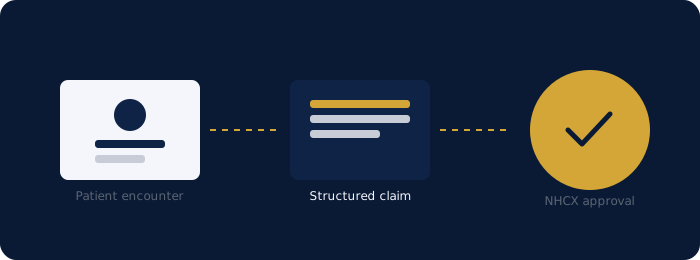
The National Health Claims Exchange (NHCX) is the government's answer to this fragmentation: a single digital gateway standardising how hospitals, insurers, TPAs, and scheme administrators exchange eligibility checks, pre-authorisation requests, and claim documents, instead of every payer running its own portal. Adoption is scaling fast — NHCX is projected to handle more than 10 crore claims annually by 2026, with the large majority of government scheme claims expected to route through it. A parallel regulatory change requires cashless claims to be processed within three hours of a hospital issuing discharge authorisation, which only works in practice if the hospital's own system can submit a structured, NHCX-ready claim bundle the moment discharge is confirmed — not after someone manually re-types the same data into a separate portal. There's also a direct financial incentive to integrate: hospitals can receive roughly ₹500 per claim transaction routed through NHCX, or 10% of the claim value, whichever is lower, under the government's digital health incentive scheme.
The de-empanelment risk nobody budgets for
PMJAY oversight has real teeth. Since the scheme's inception, the Ministry of Health has found over 3,100 hospitals guilty of irregularities, de-empanelled more than 1,100 of them, and imposed penalties exceeding ₹122 crore. Irregularities are rarely dramatic fraud — far more often they're documentation gaps: a package code that doesn't match the actual procedure performed, a missing pre-authorisation reference, or an inconsistency between the clinical record and the claim submitted. A hospital's best defence in an audit is not a good explanation after the fact; it's a system that made the correct documentation the only path available at the time of treatment.
What your hospital software actually needs to track
Concretely: eligibility verification against ABHA and the beneficiary database from inside the HIS, not a separate portal login. A pre-authorisation workflow that pulls structured clinical data directly from the encounter rather than re-keying it. HBP package-code mapping tied to what your hospital is actually authorised for, so an unauthorised package gets flagged before submission, not rejected after. Real-time claim status — submitted, queried, approved, paid — visible on the same dashboard as the rest of hospital operations. NHCX/ABDM milestone readiness (the M1/M2/M3 framework), since only milestone-certified systems can participate in NHCX-based exchange. And a clear, separate flag for current cashless status versus empanelment status, because the two can diverge and that distinction is exactly where patient-facing disputes happen at the front desk.
Where PMJAY compliance connects elsewhere
PMJAY claims processing works best alongside broader quality accreditation. NABH accreditation covers the specific package-rate premium many states offer accredited hospitals with real PMJAY volume. And for hospitals planning their PMJAY-readiness rollout timeline alongside other priorities, our guide to realistic ERP implementation timelines covers how to sequence that work.
How OneCity handles this
OneCity's PMJAY / CGHS / ECHS module maps HBP package authorisation directly to what your hospital is empanelled for, and the NHCX claims exchange module submits structured, standardised claim bundles the moment discharge is confirmed rather than as a separate manual step. Both sit inside the broader TPA / insurance claims module, which shares the same encounter and billing data as the rest of the ERP — so a pre-authorisation isn't a duplicate data-entry exercise, and every claim carries the same clinical documentation trail an NABH or PMJAY audit would ask for, covered under our incident reporting and NABH 6th edition compliance mapping.
For the wider compliance picture, see India compliance and ABDM & ABHA integration; for hospitals still evaluating platforms, our ERP selection guide for tier-2/3 hospitals covers where claims automation fits against the rest of the buying decision.
Frequently asked questions
Are all hospitals automatically empanelled under PMJAY?
No. Public hospitals at Community Health Centre level and above, in states implementing PMJAY, are deemed empanelled automatically. Private hospitals must apply for empanelment with the State Health Agency and sign a scheme MoU covering specific specialities and HBP package codes.
Does empanelled mean cashless treatment is always active?
No, and this distinction causes real disputes. A hospital can be empanelled but temporarily suspend cashless processing, commonly over pending SHA payments. Software should track current cashless status separately from empanelment status, since they can diverge.
Is NHCX mandatory for PMJAY claims?
NHCX adoption is expanding quickly, with a large majority of government scheme claims expected to route through it, and new cashless claims increasingly required to go through NHCX rather than legacy portals. Hospitals not integrated risk being routed through slower manual channels.
What happens if a hospital is found to have claim irregularities?
Consequences range from financial penalties to suspension to permanent de-empanelment. Thousands of hospitals have faced action since the scheme's inception. Clean, structured, timestamped documentation for every claim is the primary defence during an audit.
Sources and further reading
Empanelment rules for public hospitals drawn from a Press Information Bureau release on Ayushman Bharat hospital empanelment, and NHCX rollout figures and claims-delay data from a NATHEALTH report on the National Health Claims Exchange. Hospitals should confirm current empanelment and NHCX integration requirements with their State Health Agency, since rollout pace varies by state.
See PMJAY and NHCX claim tracking inside your own billing workflow
Free up to 5 doctors. No card, no setup fee.
Book a demo See pricing