
Compliance · Laboratory · 13 min read
NABL Accreditation for Medical Labs: What ISO 15189:2022 Actually Requires
NABL recently launched a new Medical Application Portal built specifically for ISO 15189:2022 applicant laboratories, restructuring the accreditation application process with standardised templates and a pre-registration checklist aimed at reducing timelines. The underlying standard itself, ISO 15189, hasn't changed in substance, but the 2022 revision and the new application infrastructure both matter for any hospital lab applying now, and most existing guides online still reference the older 2012 version without accounting for either change. What follows covers what the new portal actually changes, the realistic timeline from documentation to certification, and what a lab's own software needs to track once accreditation is granted, so the two-year cycle doesn't quietly lapse into a paperwork gap nobody notices until a surveillance audit.
What's new: the Medical Application Portal
NABL, a constituent board of the Quality Council of India, launched its new Medical Application Portal specifically designed for ISO 15189:2022 applicant laboratories, unveiled during a virtual "GOING LIVE" event. The portal reimagines the application process around how medical laboratories actually operate, introducing a restructured application flow, standardised templates, a comprehensive pre-registration checklist, and a multi-user access feature letting laboratories assign different staff members distinct access rights during the application. NABL's own leadership described it as a transformational step toward making the accreditation process more efficient and transparent, a genuine process improvement, not just a cosmetic interface update, for labs that previously used a more generic, less laboratory-specific application system.
ISO 15189:2022 versus the older 2012 revision
Much existing guidance on NABL medical laboratory accreditation still references ISO 15189:2012, the version many currently-accredited labs were originally assessed against. The 2022 revision is the current standard NABL applies to new medical laboratory applicants, and while the core structure, competence requirements for medical laboratories, quality and technical management, remains consistent in spirit, applying against outdated 2012-era guidance risks preparing documentation against requirements that no longer reflect what an assessor will actually check. A lab beginning the accreditation process now should confirm its quality manual and internal audit preparation explicitly reference the 2022 version, not assume older reference material is still fully current.
What NABL actually grants accreditation for
NABL provides accreditation across several distinct scopes: testing and calibration laboratories under ISO/IEC 17025, medical laboratories specifically under ISO 15189, proficiency testing providers under ISO/IEC 17043, reference material producers under ISO 17034, and biobanks under ISO 20387. For a hospital's diagnostic lab specifically, ISO 15189 is the relevant standard, a distinct accreditation track from the general testing and calibration standard, reflecting the specific competence and quality requirements medical testing carries compared to industrial or environmental testing labs.
The realistic accreditation timeline
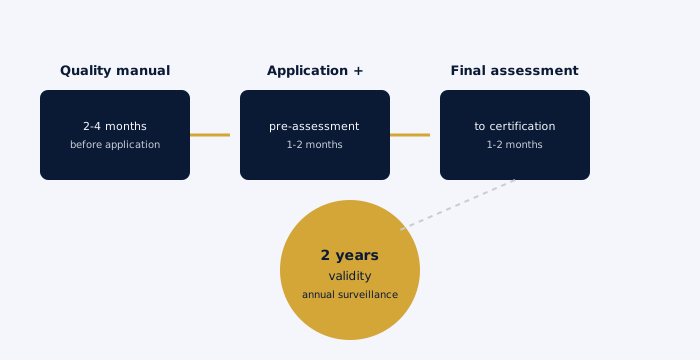
Accreditation typically takes four to eight months from initial documentation through to certification, though this depends heavily on how developed a lab's quality management system already is before the formal application begins. The process follows a structured sequence: understanding ISO 15189's specific requirements alongside NABL's own supplementary criteria document (NABL-112), developing a quality manual covering both, conducting internal audits and management review, and then submitting to NABL for a staged assessment, typically a pre-assessment review followed by a final on-site assessment. A lab that starts building its quality manual only after submitting the application, rather than treating documentation as groundwork completed beforehand, is the single biggest reason the process stretches toward the long end of that range.
| Stage | Typical duration |
|---|---|
| Quality manual + internal audit prep | 2-4 months (before formal application) |
| Application + pre-assessment | 1-2 months |
| Final assessment to certification | 1-2 months |
| Accreditation validity | 2 years, with annual surveillance |
What happens after accreditation is granted
NABL accreditation is valid for two years, not indefinitely, and annual surveillance audits are required in between to maintain that status, accreditation is an ongoing quality commitment, not a certificate earned once and filed away. A lab that treats the two-year mark as the only checkpoint, skipping genuine attention to quality processes in the interim, risks discovering gaps only when the surveillance audit or renewal assessment happens, rather than catching drift in real time through its own internal monitoring.
Why NABL accreditation matters even without a legal mandate
NABL accreditation isn't legally mandatory for most hospital labs in India, but it functions as a strong practical necessity rather than a purely voluntary quality signal. It's increasingly expected by government schemes and private insurance networks evaluating which labs to trust for claims tied to diagnostic results, and referring physicians and patients increasingly recognise NABL accreditation as a baseline credibility marker when choosing where to send a sample. A hospital lab without accreditation isn't operating illegally, but it's competing at a real disadvantage against accredited labs for exactly the referral and scheme-linked volume that matters most to a lab's actual patient throughput.
Common preparation mistakes
The most frequent mistake is starting the formal NABL application before the underlying quality management system is genuinely operational, a lab that treats the quality manual as a document written to satisfy the application, rather than a description of practices already actually followed day to day, struggles the moment an assessor asks staff to demonstrate the process rather than just describe it. A second is applying against outdated 2012-era guidance instead of confirming current ISO 15189:2022 requirements. A third is treating internal audits as a one-time pre-application exercise rather than an ongoing practice that continues after accreditation, which is exactly what the annual surveillance audit expects to see evidence of.
What lab software needs to support
Genuinely NABL-ready lab software needs to maintain the specific documentation trail an assessor reviews, sample handling records, quality control run history, calibration records for equipment, and staff competency records, in a structured, retrievable format, not scattered across paper logs and separate spreadsheets. It needs to support internal audit tracking as an ongoing practice, not a one-time checklist. And it should flag when surveillance audit or renewal dates are approaching, tied to the lab's actual two-year accreditation cycle, rather than leaving that tracking to institutional memory.
NABL versus NABH: two accreditation bodies, different scope
Hospitals sometimes conflate NABL and NABH because both are QCI-affiliated and both matter for hospital quality, but they assess genuinely different things. NABH accredits the hospital or healthcare organisation as a whole, patient safety, clinical documentation, infection control, facility management across the entire institution. NABL accredits the laboratory specifically, against the technical competence and quality management requirements of ISO 15189, focused narrowly on testing accuracy, sample handling, and equipment calibration within the lab itself. A hospital can pursue NABH accreditation for the institution and NABL accreditation for its diagnostic lab simultaneously, and many do, since the two credentials answer different questions for referring physicians and patients, one about the hospital broadly, one about whether a specific test result can be trusted.
What documentation actually gets checked during assessment
An NABL assessor doesn't review a quality manual in isolation, they check whether documented procedures match what staff actually do at the bench. This means proficiency testing participation records, internal quality control charts showing ongoing monitoring rather than a single historical data point, equipment calibration certificates that are genuinely current rather than expired and unnoticed, and staff training records tied to specific competencies rather than generic onboarding paperwork. A lab that has excellent testing accuracy in practice but can't produce this documentation trail coherently faces the same problem an NABH applicant faces with scattered paper records, the underlying quality may be real, but the assessment can't verify what it can't see documented.
Multi-site labs and consistent accreditation scope
A hospital group running diagnostic labs at several locations needs to think carefully about accreditation scope, NABL accreditation applies to the specific tests and processes assessed at a specific facility, not automatically to every similar lab a group operates elsewhere. A group with one NABL-accredited flagship lab and several unaccredited satellite labs running similar tests presents an inconsistent quality picture to referring physicians and patients, who may reasonably assume accreditation covers the whole network rather than one specific site. Extending accreditation scope, or at minimum being transparent about which specific locations hold which specific accreditation, avoids a credibility gap that surfaces awkwardly when a patient or insurer asks directly.
Choosing which tests to bring under initial accreditation scope
A lab doesn't need every test it offers accredited from day one, NABL accreditation is granted per specific test parameter, and most labs start with a defined scope covering their highest-volume or most clinically critical tests, expanding scope in subsequent assessment cycles rather than attempting comprehensive coverage immediately. This staged approach is a genuine strategic choice, not a compromise: a lab that tries to bring fifty test parameters under accreditation simultaneously on a first application takes on documentation and quality-control burden across all fifty at once, whereas a lab starting with its ten highest-priority tests can demonstrate genuine competence there first and extend scope with a track record already established.
Why proficiency testing participation matters beyond the assessment
External quality assessment through proficiency testing, where a lab's results on a standardised sample are compared against a peer group or reference value, is both an NABL requirement and a genuinely useful ongoing quality signal independent of accreditation status. A lab participating seriously in proficiency testing catches systematic errors in its own testing process before they affect real patient results, not just before an assessor reviews the paperwork. Treating proficiency testing as a compliance checkbox to satisfy NABL, rather than a genuine quality tool a lab should want regardless of accreditation requirements, misses the actual value the requirement is designed to provide.
What tier-2/3 hospital labs specifically should weigh
A smaller hospital lab evaluating NABL accreditation faces a different calculus than a large diagnostic chain. Accreditation costs, application fees, documentation preparation time, potential consultant support, represent a proportionally larger investment for a smaller lab's budget, and the four-to-eight-month timeline competes with limited administrative bandwidth already stretched across other priorities. But the competitive case is often stronger, not weaker, for a smaller lab specifically: in a market where larger chains increasingly hold NABL accreditation as standard, a tier-2/3 hospital lab without it risks looking meaningfully behind on quality signalling exactly where referral competition is most direct. Starting with a narrow, well-chosen initial scope, rather than deferring accreditation entirely until the lab feels "ready" for comprehensive coverage, is usually the more realistic path for a smaller lab to close that gap.
Building the quality culture before the application, not for it
The labs that move through NABL assessment smoothly are consistently the ones where the quality management system predates the decision to pursue accreditation, internal audits, calibration tracking, and proficiency testing were already genuine practice, and the application process formalised documentation of something already operating, rather than introducing new practices solely to pass assessment. A lab starting from close to zero, building an entire quality system specifically to satisfy NABL, faces a harder and slower path, and often produces documentation that looks correct on paper without yet reflecting genuinely embedded practice, exactly the gap an experienced assessor is trained to probe during a site visit rather than take at face value.
Where NABL accreditation connects to your broader quality picture
NABL accreditation is one piece of a hospital's broader quality and compliance picture. NABH accreditation assesses the institution as a whole, while lab-specific equipment falls under AERB licensing for radiology and imaging equipment specifically. Hospitals coordinating multiple accreditation efforts simultaneously should also see our guide to realistic ERP implementation timelines, which covers how to sequence overlapping compliance projects. If your lab also handles canteen or dietary services, FSSAI licensing follows similar per-facility logic. For hospitals weighing whether a unified platform is worth the switch, why tier-2/3 hospitals need a unified ERP makes the case, and our pricing guide covers what that transition actually costs, with the full module list showing how lab accreditation tracking fits alongside everything else.
Related compliance pages: fire safety NOC, HAI surveillance and infection control, blood bank management, and emergency and casualty management.
How OneCity supports NABL-ready lab operations
OneCity's laboratory information system tracks quality control runs, sample handling, and equipment calibration records in the structured format NABL assessors expect, alongside the same quality and audit tracking used across other accreditation requirements. For hospitals pursuing both NABH and NABL accreditation simultaneously, a common combination for hospital-based labs, this shared documentation trail avoids maintaining separate, disconnected quality systems for two accreditation bodies reviewing much of the same underlying operational discipline. See our related guide on hospital laboratory information systems and NABL for the software-feature side of this in more depth.
Frequently asked questions
Is NABL accreditation legally mandatory for hospital labs in India?
No, NABL accreditation is not legally mandatory in most cases, but it is increasingly required by government schemes and private insurance networks, and is treated as a strong quality signal by referring hospitals and patients.
How long does NABL ISO 15189 accreditation take?
Typically 4 to 8 months from initial documentation to certification, depending on how prepared the lab's quality management system is before applying, followed by a pre-assessment and final assessment visit.
How long does NABL accreditation last once granted?
NABL accreditation is valid for 2 years, with annual surveillance audits required in between to maintain the certification rather than a single assessment covering the full period unchecked.
What changed with NABL's new Medical Application Portal?
NABL launched a new portal specifically for ISO 15189:2022 applicant laboratories, restructuring the application flow with standardised templates, a pre-registration checklist, and multi-user access, aimed at reducing timelines and improving accuracy compared to the previous process.
Sources and further reading
The Medical Application Portal launch is reported directly by the Press Information Bureau, and accreditation process and scope detail is drawn from NABL's own published accreditation process and scope page. Confirm current requirements directly on the NABL portal before starting an application.
Keep quality control, calibration, and audit records NABL-ready
Free up to 5 doctors. No card, no setup fee.
Book a demo See pricing