
Pricing · Buying Guide · 14 min read
Hospital Management Software Pricing in India: What It Actually Costs
Published market estimates for hospital management software in India range from roughly ₹25,000 a year for a small clinic to well over ₹1 crore for a large multi-specialty enterprise build. That's not a typo, it's the real spread you'll find across vendor sites and buying guides, and it's exactly why most hospital administrators end up on three sales calls before anyone tells them a number. This piece covers what actually drives that price gap, why so many vendors keep pricing off their websites entirely, and what OneCity charges instead of a quote request.
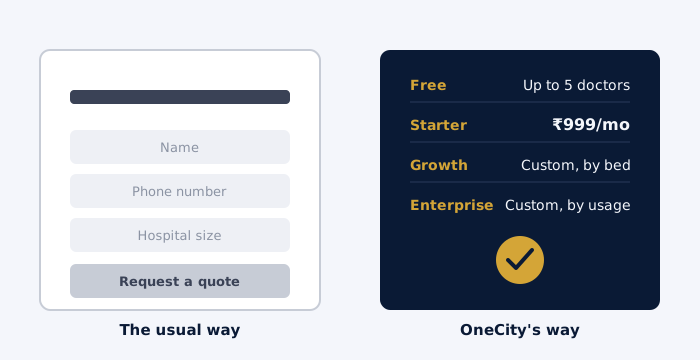
If you just want the number: OneCity's plans start free for up to five doctors and ₹999 a month for the Starter tier, published on the pricing page, no sales call required to see it.
What hospital management software actually costs, by source
Every published pricing guide gives a different number, because every guide is measuring a different mix of vendors and deployment types. Rough patterns that show up consistently: small clinics and single-doctor setups tend to land between ₹25,000 and ₹50,000 a year on basic cloud plans. Mid-size hospitals with lab and pharmacy modules typically see ₹1–5 lakh a year. Cloud-based SaaS pricing specifically, the model OneCity and most modern vendors use, commonly runs ₹5,000 to ₹50,000 a month depending on modules and user count. Large, heavily customised, on-premise enterprise builds are where the numbers stop being comparable at all: quotes from ₹40 lakh to over ₹1 crore appear in vendor pricing guides for full-suite, multi-location, highly customised systems.
| Facility type | Typical published range |
|---|---|
| Small clinic, 1–20 beds | ₹25,000 – ₹50,000/year |
| Mid-size hospital, 25–100 beds | ₹1 – 5 lakh/year |
| Cloud SaaS, general | ₹5,000 – ₹50,000/month |
| Large custom enterprise build | ₹40 lakh – ₹1 crore+ |
Take all of these as directional, not authoritative, they come from vendors' own marketing pages, which have an obvious incentive to make their own number look reasonable next to the range. That's precisely the problem the rest of this piece is about.
Why most vendors won't put a number on the page
Search for hospital software pricing in India and the dominant pattern isn't a price, it's a form. "Get a custom quote," "book a demo for pricing," "contact our sales team." This isn't an accident of web design. Custom-quote pricing lets a sales team price each deal based on what a specific hospital seems able to pay, not a fixed rate card, and it means nobody can screenshot your price and take it to a competitor for a better offer. Multiple industry buying guides note this pattern explicitly, and independent aggregator sites now exist specifically because it's hard to find real numbers otherwise. It's a rational business strategy, and it's also exactly why buyers end up doing math on the back of an envelope after three separate sales calls instead of comparing two web pages side by side.
What actually drives the price, once you get a number
Whatever number a vendor eventually gives you, the same handful of factors are doing the work behind it. Module count is the biggest lever, OPD and billing alone costs far less than OPD, IPD, pharmacy, lab, radiology, and HR combined. User and device count matters for per-seat pricing models. Cloud versus on-premise changes both the upfront number and the ongoing hosting cost; cloud hosting alone commonly runs ₹50,000 to ₹3 lakh a year as a separate line item in some enterprise quotes. Customisation, a hospital's specific workflow, a non-standard billing rule, a state-specific compliance form, adds real development cost, and vendors who quote low often make it back here. And annual maintenance, typically 10–15% of the software's value per year, is easy to forget when comparing an initial quote.
The trap: sticker price versus total cost of ownership
The cheapest quote is rarely the cheapest system over three years. A low headline price with per-transaction billing fees, a mandatory paid onboarding package, or a renewal that jumps 20% in year two can end up costing more than a transparent, slightly higher monthly rate that doesn't change. Multiple pricing guides in this space explicitly warn buyers to calculate total cost of ownership, software plus implementation plus training plus support plus renewal, rather than comparing first invoices. That's sound advice regardless of which vendor you're evaluating, including this one: ask any vendor for the three-year number, not just the first one.
What OneCity actually charges
OneCity's pricing is published, not quoted. The Free tier covers up to 5 doctors with core OPD, billing, and pharmacy basics at one location, no card required to start. The Starter tier is ₹999 a month for a single tier-2/3 hospital, covering IPD and wards, lab and radiology orders, and biomedical waste manifest tracking. Growth and Enterprise tiers scale by bed count, doctor count, encounter volume, and claim volume for larger or multi-location operations, with exact current rates on the pricing page rather than behind a sales call.
Questions to ask before you sign anything
Whichever vendor you're evaluating, a short list of questions tends to surface the real cost fast. What's included at this price, specifically, and what triggers an upsell? Is there a per-transaction or per-claim fee on top of the subscription? What does implementation and data migration cost separately from the software licence? What's the renewal price after year one, in writing, not verbally promised? And can existing customers at your hospital size be contacted as references? A vendor that answers all five without hesitation is a vendor whose pricing model can survive daylight.
SaaS subscription versus one-time licence: which costs less
Beyond cloud versus on-premise, there's a separate question of payment structure. A one-time licence with an annual maintenance contract puts a large number on the table upfront, often the ₹3–6 lakh basic clinic HMS range or higher, with a smaller recurring AMC afterward, typically 10–15% of the licence value per year. A SaaS subscription spreads the same functionality across monthly payments with little or no upfront cost, which is easier on a tier-2/3 hospital's cash flow but means the vendor relationship is easier to end if service quality drops, which cuts both ways, since a vendor who knows you can walk away has more reason to keep service quality up. Neither structure is universally cheaper; it depends on your time horizon. A hospital planning to run the same system for eight-plus years may come out ahead on a one-time licence's math. A hospital that wants the option to switch vendors without writing off a large sunk cost generally comes out ahead on subscription pricing, which is the model OneCity and most modern cloud-first vendors use.
A worked example: three-year cost, two ways
Take a hypothetical 40-bed tier-2/3 hospital. Vendor A quotes ₹4 lakh upfront for a licence plus 12% AMC (₹48,000/year), with a separate ₹60,000 one-time implementation fee and per-claim TPA processing fees that typically run another ₹40,000–60,000/year at moderate claim volume. Rough three-year total: roughly ₹4 lakh + ₹60,000 + (₹48,000 × 3) + (₹50,000 × 3) ≈ ₹6.5 lakh. Vendor B, a transparent SaaS model at, say, ₹5,000/month with no separate implementation fee and no per-claim charges, comes to ₹5,000 × 36 months ≈ ₹1.8 lakh over the same three years. The numbers here are illustrative, not a real quote from either vendor, but the exercise itself is the point: run this same math against any two real quotes you receive, using their actual figures, before deciding based on the first invoice alone.
The gap in this example is dramatic partly because it's illustrative, but the underlying pattern, a large upfront licence plus stacked recurring fees versus a flat transparent subscription, shows up in real comparisons too, just usually with a narrower spread. The point of running this exercise isn't to prove subscription pricing always wins; it's that you can't know which model actually costs less for your hospital until you've done the three-year arithmetic with real numbers from both vendors, not just compared the headline figures each one leads with in the first sales call.
Red flags in a vendor sales conversation
A few patterns are worth treating as warning signs rather than normal sales friction. A vendor who won't put a rough range in writing over email, insisting every conversation happen live on a call, is optimising for their own negotiating position, not your ability to compare offers calmly. A quote that changes meaningfully between the first and second call, with no change in your stated requirements, suggests the first number was an anchor rather than a real estimate. Pressure to sign within 48 hours for a "special rate" is a classic urgency tactic that has nothing to do with your hospital's actual timeline. And a vendor who can't name three existing customers at a similar bed count willing to take a reference call is either very new or has a support history they'd rather you not check.
What "free" actually means in hospital software pricing
Several vendors, OneCity included, offer a genuinely free tier rather than a time-limited trial. The distinction matters: a free trial is a sales funnel with an expiry date built in, designed to convert you before you've had time to properly evaluate fit. A free tier with no expiry, OneCity's covers up to 5 doctors on core OPD, billing, and pharmacy basics, lets a small clinic or a single department pilot the actual software on real patients for as long as it makes sense, with no clock forcing a decision. When evaluating any vendor's "free" offer, the one question worth asking directly is whether it expires, and if so, when, and what happens to your data if you don't upgrade in time.
None of this is complicated once you know to look for it, the challenge is simply that most hospital software pricing is deliberately built to be looked at once, in a sales call, without time to compare. Slow that process down. Ask for numbers in writing. Run the three-year math on any quote before signing it. And treat a vendor's willingness to show you the actual price, before you've given them your phone number, as a genuine signal about how the rest of the relationship will go, and treat silence on any of these questions as an answer in itself.
How GST and compliance costs get bundled, or don't
One line item that frequently splits vendors is India-specific compliance: GST e-invoicing with correct Tax Invoice versus Bill of Supply logic, NABH-aligned documentation, ABDM/ABHA integration, and biomedical waste manifest tracking. Some vendors bundle all of this into the base price on the reasonable logic that it's not optional for an Indian hospital; others treat each as a paid add-on module, which is where an attractively low base quote can balloon once you add back the pieces you actually need to operate legally. Before comparing two prices, confirm both quotes include the same compliance scope, otherwise you're comparing a stripped configuration against a complete one and calling it an apples-to-apples decision.
Common mistakes hospitals make when comparing quotes
The most frequent mistake is comparing two numbers that don't cover the same scope, one quote includes implementation and training, the other doesn't, and the buyer never notices until the invoice. A second is choosing purely on price without checking whether the workflow actually fits; a cheap system that doesn't match how your OPD actually runs costs more in lost productivity than the subscription ever saved. A third is skipping the reference-customer check, a vendor with zero verifiable hospitals at your bed-count range operating on their platform for over a year is a real risk regardless of how polished the pricing page looks. And a fourth, specific to India, is not confirming NABH, ABDM, and GST e-invoicing support are included rather than a paid add-on module bolted on after the fact.
How to tell if a vendor's transparency is real or cosmetic
Not every vendor who publishes a number is being fully transparent, and it's worth checking before assuming a published price tells the whole story. A genuinely transparent pricing page states what's included at each tier in enough detail that you could build a rough feature checklist without a sales call. It states whether GST, NABH documentation, and ABDM support are included or separate. It states, or at minimum doesn't hide, what happens at the free-tier limit, do you get a warning before losing access, or does data become read-only without notice. And it's specific about what counts toward usage limits: is a "doctor" on the plan counted by active login, by roster entry, or by something else entirely, since vendors have been known to define these terms in whatever way makes the published number look most attractive. A published price with none of this supporting detail is a marketing number, not a real quote, ask the same five questions from the sales-conversation section above even when the number itself is public.
Why this matters more for tier-2/3 hospitals specifically
A large metro hospital chain has a finance team that can absorb a surprise renewal increase or a miscalculated total cost of ownership without it threatening operations. A 30-bed hospital in a tier-2 or tier-3 city typically doesn't have that cushion, a software budget surprise competes directly with equipment purchases, staff salaries, and working capital for medicine stock. That's the specific reason pricing transparency matters more here than it does for enterprise buyers who have a procurement department built for exactly this kind of vendor evaluation. A tier-2/3 hospital administrator is very often doing this evaluation alone, alongside their actual job running the hospital, which is precisely the buyer a hidden-pricing sales process is hardest on.
For a typical tier-2/3 hospital, the realistic planning number is the subscription cost plus a genuine allowance for data migration effort, even a modest one, since moving from paper or spreadsheets always takes staff time whether or not the vendor charges for it directly. Budget for a training period where productivity dips before it improves, typically two to four weeks for a modest rollout. And build in the assumption that whatever the year-one number is, year two may include a renewal increase, ask upfront what that increase has historically looked like for existing customers, not just what this year's quote says.
Where pricing decisions connect to the rest of your evaluation
Pricing rarely gets decided in isolation from the rest of a hospital's software evaluation. Our guide to realistic ERP implementation timelines covers how rollout duration interacts with the pricing tier you choose, and how to choose hospital management software walks through the broader evaluation criteria beyond price alone. Hospitals weighing NABH accreditation specifically should see our guide to NABH accreditation software, which covers the real PM-JAY reimbursement premium that can offset subscription costs directly. If you're still deciding between a unified platform and stitching together point solutions, why tier-2/3 hospitals need a unified ERP covers the hidden costs of the fragmented approach. See the complete module list for what's included at each tier, and our comparison against Practo for how OneCity stacks up against a specific alternative. For a broader look at what "best" actually means across vendors, see our guide to the best hospital management software in India, and our demo booking page if you'd rather see actual pricing applied to your own bed count directly.
Related module and compliance pages: blood bank management, emergency and casualty, fire safety NOC, and HAI surveillance.
Frequently asked questions
Why won't most hospital software vendors publish their prices?
Custom-quote pricing lets a vendor charge each hospital what the sales team thinks it can get, based on perceived budget and urgency, rather than a fixed rate card. It also hides how a small starter plan compares to a competitor's, since there's nothing public to compare.
Is cheaper hospital software actually cheaper in the long run?
Not necessarily. A low sticker price with high per-transaction fees, mandatory paid onboarding, or steep annual renewal hikes can cost more over three years than a slightly higher transparent monthly rate. Total cost of ownership, not the first invoice, is what matters.
What's a reasonable monthly cost for a tier-2/3 hospital?
Published market ranges for cloud-based SaaS hospital software commonly fall between roughly ₹5,000 and ₹50,000 a month depending on modules, users, and hospital size, though on-premise and heavily customised enterprise builds run well beyond that.
Does OneCity charge per bed or per doctor?
OneCity's published pricing scales by bed count, doctor count, encounter volume, and claim volume depending on tier, starting free for up to 5 doctors and ₹999/month for the Starter tier, see the pricing page for exact current rates.
Should a hospital ever pay a large upfront licence fee instead of a subscription?
It can make sense for a hospital with a long planning horizon and available capital, since the multi-year math sometimes favours a one-time licence over subscription payments. For a tier-2/3 hospital with tighter cash flow and less certainty about a five-year-plus commitment to one vendor, a transparent subscription with no large upfront cost is usually the lower-risk choice, since it caps the downside if the vendor relationship doesn't work out.
Sources and further reading
Market pricing ranges referenced in this piece are drawn in part from a hospital software pricing guide published by Cufront, and from a detailed cost breakdown published by Secuodsoft. Figures vary meaningfully across sources and vendor pricing changes over time, confirm current numbers directly with any vendor you're evaluating, including this one. Where a range is cited above without a specific source, it reflects a pattern repeated across multiple independent pricing guides rather than a single vendor's claim, which is the most reliable signal available in a market where few companies publish audited pricing data.
Related reading: our guide on how to choose hospital management software in India covers selection criteria beyond price, and the best hospital ERP options for tier-2/3 hospitals covers where OneCity fits against alternatives. For the compliance side of a purchase decision, see NABH 6th edition and GST e-invoice compliance.
See the actual price before you talk to anyone
Free up to 5 doctors. No card, no setup fee, no sales call required to see the number.
See pricing Book a demo